
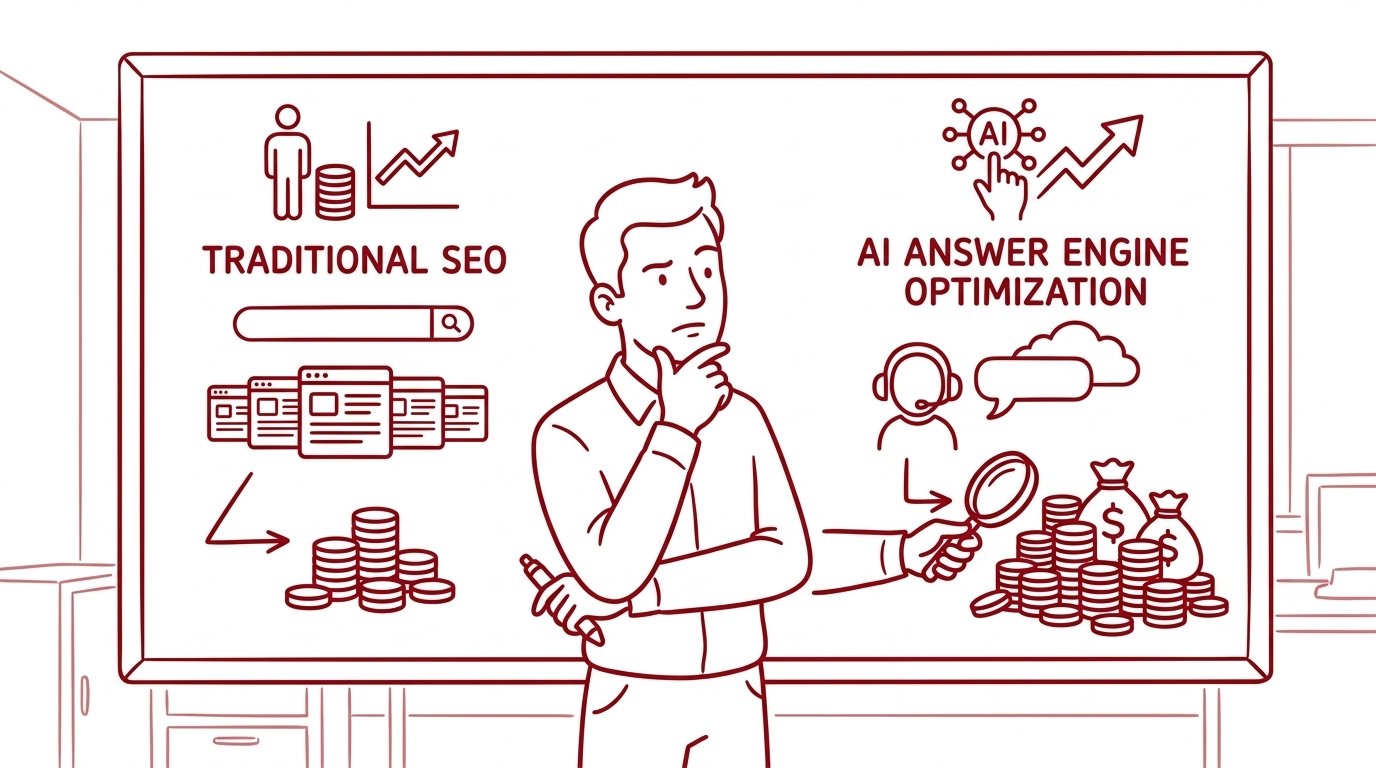
AEO vs SEO
The two disciplines share a foundation, but they optimize for different outcomes. SEO makes your website technically readable and works to rank it high for target keywords, historically against one dominant algorithm: Google. AEO structures your content so AI agents can retrieve it and cite it inside a composed answer, across many engines at once. Semrush puts it plainly: SEO is about ranking in search engines, while AEO is about being included in AI-generated answers.[1]
On Episode 2 of Cited Conversations[2], Simon Wilhelm, Co-Founder and CEO of SCAILE, drew the line like this: “SEO is optimizing for also technical readability of your website and optimizing to rank high for certain keywords. And AEO is really understanding the intent of your customer.” He went on to explain why the second job is harder: every engine works differently. ChatGPT has its own index, Perplexity searches the web, and Claude searches through Brave. In traditional SEO you were mostly targeting Google and one algorithm. Now you are serving many algorithms and many personas at once.
Those differences show up in three places that matter when you allocate budget:
| Traditional SEO | AEO | |
|---|---|---|
| Goal | Rank high in organic search to earn traffic | Get cited or mentioned inside AI-generated answers |
| Discovery surface | Links, featured snippets, AI Overviews | AI answers, citations, brand mentions |
| Success metric | Rankings and organic traffic | AI mentions, citations, share of answer |
In short: ranking versus citation, links versus answers, traffic versus visibility. If you want the full primer on the discipline before deciding how to fund it, our guide to What Is AEO walks through how AI agents evaluate and cite B2B brands.
AEO versus traditional SEO
The mechanical limit of keyword-first investment is that the click keeps disappearing before your ranking pays off. Buyers get their answer on the results page, or increasingly inside an AI response, and never reach the blue link you optimized. Three numbers frame the shift:
- 68.01% of US Google searches ended without a click in the first four months of 2026, up from 60.45% in 2024, according to SparkToro and Similarweb. That is the fastest acceleration of zero-click behavior in a decade.[3]
- Gartner predicted that traditional search engine volume will drop 25% by 2026 as AI chatbots and other virtual agents absorb queries that used to run through search engines.[4]
- Google's AI Overviews now appear on more than 20% of all searches, and when they are present they cut click-through by nearly 60%.[3]
For a B2B brand, the consequence is uncomfortable but simple: a ranking without a citation earns no visibility in an answer. When a buyer asks an AI agent about your category, the agent composes its response from a handful of sources it trusts. Position three on Google does nothing for you if the answer never says your name. As Simon Wilhelm, Co-Founder and CEO of SCAILE, told buyers pitching AI visibility to their boards on Episode 2 of Cited Conversations: “If we're not investing into this channel, we're going to be invisible or absent even though we might have great brand reputation.”
None of this is an argument for zeroing out the legacy budget. The foundations of the two disciplines overlap heavily, and Semrush's comparison research found that AI favors trusted domains: strong organic rankings and authority make a domain more likely to be cited. AI engines also often pull deeper subpages, blog posts, and documentation within trusted domains rather than the exact URLs that rank, which means a crawlable, authoritative site remains the access layer for AI retrieval.[1]
So before you move a single dollar, know what you are protecting. The assets worth keeping funded are:
- Technical health and crawlability, because AI crawlers cannot retrieve what search engines cannot reach
- Domain authority and backlinks, which Semrush found are associated with greater visibility in AI search
- Deep, well-structured content on trusted subpages, since that is where AI engines often pull their citations
- The clicks that still happen, because nearly a third of Google searches still send one[3]
SparkToro's own advice captures the balance: your SEO still matters as much or more than ever, it just won't earn you traffic the way it once did.[3] Podcasting fits the same pattern, complementing search rather than replacing it; we compared the two channels' long-term value in SEO vs. podcasts.
The economics of the two channels are diverging, and not in the direction most budget plans assume. Semrush's study across more than 500 topics found the average AI search visitor is worth 4.4 times the average traditional organic visitor by conversion rate, because by the time an AI-referred visitor reaches your site they have already compared options and absorbed your value proposition. The same study projects AI search visitors surpassing traditional search visitors by 2028 for the topics it studied.[5]
Measurement shifts accordingly. Rankings and sessions matter less; brand mentions, citations, and share of answer matter more. As Simon Wilhelm, Co-Founder and CEO of SCAILE, put it on Episode 2 of Cited Conversations: “traffic will become a vanity metric,” because what counts is how often you are the answer when a buyer asks. We break down the metrics that actually matter in our guide to measuring AI search visibility.
One more number keeps this honest: Gartner's survey of 645 B2B buyers found 69% prefer to validate AI-generated insights with sales reps.[6] Visibility in AI answers does not replace the human conversation. It feeds it, so your team walks into warmer rooms. And a note on scoreboards: neither channel should be judged on download numbers or promised rankings. Visibility, measured honestly, is the metric.
B2B search budget
You came for the split, so here it is. Similarweb's budget guidance is to keep 70-80% of search spend on core SEO (technical foundations, on-page work, authority) while ring-fencing a dedicated 20-30% slice for AI optimization so the new work never cannibalizes the old.[7] A practical framework looks like this:
- Hold 70-80% of the search budget on core SEO: technical health, on-page optimization, and authority building. This is the foundation AI citation leans on.
- Ring-fence the remaining 20-30% as a separate line for AI optimization, so the two budgets are visible and accountable on their own.
- Spend the new slice on re-sequencing hours you already have before adding headcount: answer-first rewrites of existing pages, structured data, and entity cleanup.
- Set a review cadence tied to AI referral share rather than treating this as a one-time reallocation. Similarweb recommends reviewing results quarterly and adjusting based on what the data shows.[7]
Similarweb's pro tip applies to teams of any size: start with a pilot on one product category or business line, prove the value, then scale the allocation.[7]
A framework gives you a starting split. Decision criteria tell you how fast to move it, because the right ratio depends on how AI-heavy your category's buying journey actually is. Semrush's survey of more than 600 US B2B professionals found 66% regularly use AI to research vendors and solutions, and 92% say AI has shaped their vendor shortlist.[8] Before you shift budget, check three things:
- Competitor presence: ask AI agents the questions your buyers ask about your category. If competitors show up and you don't, the case for shifting budget writes itself.
- Content structure: audit whether your current content is built so AI agents can parse and cite it. Clear headings, extractable answers, named experts, and consistent entity signals all make citation possible.
- Category AI intensity: weight the shift by how much of your buying journey runs through AI. Where shortlists are heavily AI-shaped, the ring-fenced slice deserves more, sooner.
Answer engine optimization vs SEO
Whatever split you land on, every AEO program is only as good as its raw material. Semrush's B2B survey found only 7% of buyers notice a vendor in an AI response because they recognize the name; what makes a vendor stand out is how precisely it matches the buyer's use case.[8] Generic, AI-generated commodity content cannot deliver that precision, because it says what every other page says. Original, human-sourced expert content can.
That is the work a content capture engine does. Through the Plan, Capture, Transform framework, one 45-minute conversation becomes 5 to 15 structured answer assets: Q&A blocks, definition pages, comparison tables, step-by-step guides, and a hub page. The transform stage produces exactly the extractable, entity-rich formats AI agents can consume and cite. The capture engine produces the raw material; your AEO partner optimizes it for visibility. The two are complementary, not overlapping.
If you want to see the capture-to-citation pipeline end to end, our guide to human to AI content workflows walks through it step by step. And if you want the logistics off your team's plate entirely, Ringmaster Professional is the managed tier where you commit about one hour per week of expert time and the team handles guest sourcing from your ICP, capture, and everything in between. You bring the expertise and the relationships. The capture engine does the heavy lifting, and your AEO investment finally has something worth optimizing.
Frequently asked questions
What is the difference between AEO and traditional SEO?
SEO optimizes your site's technical readability and content to rank for keywords in a list of links, historically on one dominant engine. AEO structures content so AI agents cite it inside a composed answer, across multiple engines that each use different indexes and retrieval paths. The success metric shifts from rankings and traffic to brand mentions, citations and share of answer.
Is AEO replacing SEO?
No, and treating it as a replacement is where most budget mistakes start. Semrush research found AI engines favor trusted domains, so strong organic authority makes citation more likely. But the click economy is shrinking: Gartner predicted traditional search volume will drop 25% by 2026, and 68.01% of US Google searches already end without a click. The two disciplines compound rather than compete.
How much of my search budget should go to AEO?
Similarweb's guidance for 2026 keeps 70-80% of search spend on core SEO (technical foundations, on-page work, authority building) and ring-fences a dedicated slice for AI optimization. Much of the AEO work reuses hours you already spend, so start by re-sequencing existing effort, then scale the dedicated slice as AI referral share grows in your category.
Does good SEO help you get cited by AI engines?
Partly. Semrush found that strong organic rankings and domain authority make a domain more likely to be cited, but AI engines often pull deeper subpages, blog posts or documentation within a trusted domain rather than the exact URL that ranks. So SEO gets you into the trusted pool, while answer-first structure and formatting determine whether your content actually gets quoted.
How do you measure the ROI of AEO?
Track AI brand mentions, citations and share of answer for your target topics rather than traffic or downloads alone. Semrush's study found the average AI search visitor is worth 4.4 times the average traditional organic visitor by conversion rate, so even small AI referral volumes can carry outsized value. Tools like Otterly AI can show before and after visibility.
Should B2B companies stop investing in SEO?
No. Google still sends the majority of clicks that do happen, and AI engines favor trusted, authoritative domains, so the SEO foundation is what makes AEO credible. The smarter move is re-sequencing the budget you already have: protect the technical and authority work, and redirect commodity content hours toward structured, citable expert content.