
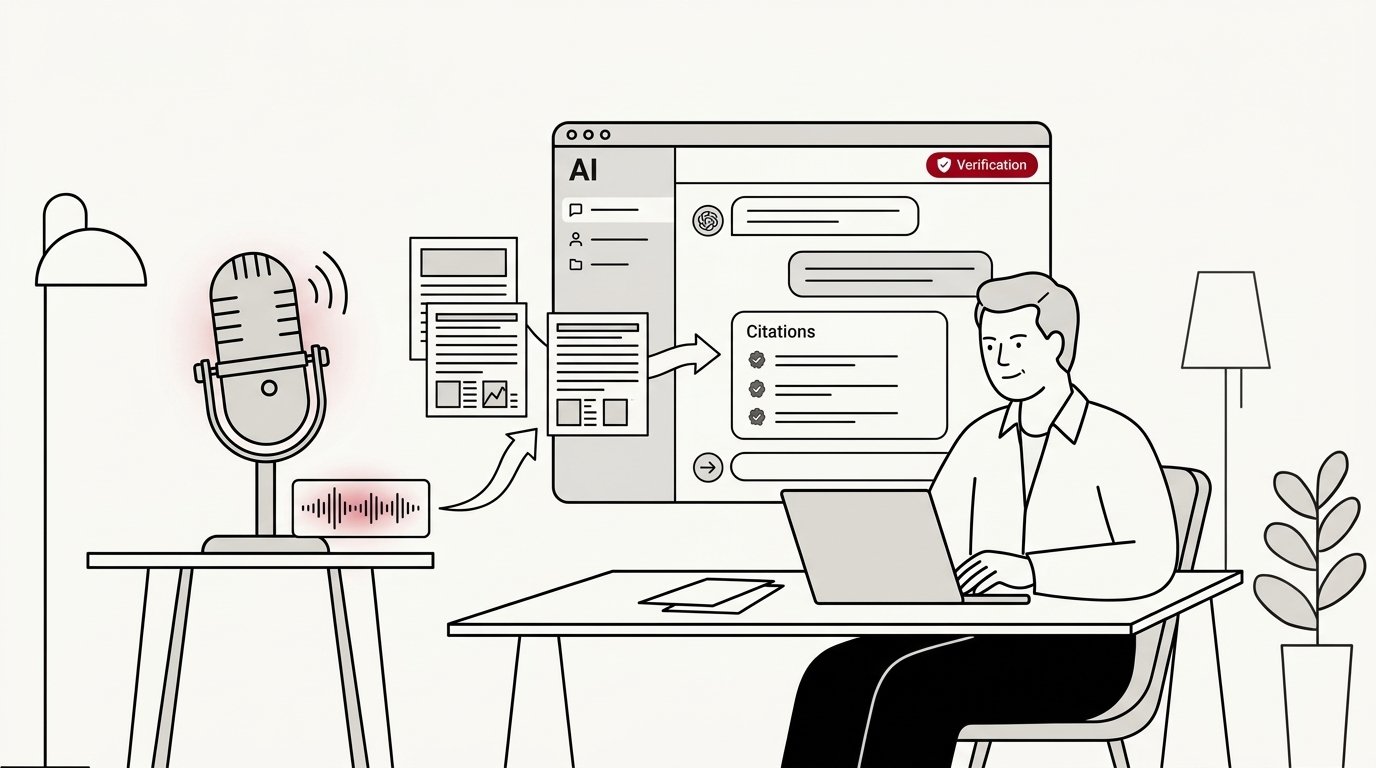
What Is AEO?
Answer Engine Optimization (AEO) is the practice of structuring your content and brand presence so AI answer engines like ChatGPT, Perplexity, Claude, Gemini, and Google AI Overviews can understand, cite, and recommend your brand. Simple definition, big shift. For two decades, visibility meant a spot on a results page. Now it means being quoted inside the answer itself.
Here's what actually happens when a buyer asks an AI agent a question. The engine doesn't hand them ten links and let them choose. It retrieves a small set of sources it trusts, synthesizes them into one response, and cites a handful of names. Your buyer meets a finished answer. If your brand isn't in the source set, you're not in the conversation. Literally.
Why AEO isn't SEO with a new name
It's tempting to file AEO under 'SEO, 2026 edition.' Resist that. The two disciplines reward different things. In SEO, keywords signal relevance and links signal authority. In AEO, context and content depth establish authority. An AI agent wants to know whether your content demonstrates genuine expertise on a narrow question, whether real people with real credentials stand behind it, and whether other trusted sources corroborate it.
- SEO optimizes for a results page. AEO optimizes for a synthesized answer.
- SEO rewards keyword relevance. AEO rewards context, depth, and entity-rich expertise.
- SEO wins a click. AEO wins a citation inside the answer, before any click is possible.
That last line is the whole game. Visibility is shifting from click-based to citation-based. In a randomized field experiment run with 1,065 desktop Chrome users by researchers at the Indian School of Business and Carnegie Mellon, Google's AI Overviews cut outbound organic clicks by 38% on queries where they appeared, and zero-click search rose from 54% to 72%[1]. The click is no longer the unit of visibility. The citation is. Martech analyst Scott Brinker has been tracking exactly this transfer of control in the customer's journey, and the data says it's accelerating.
Answer Engine Optimization for B2B: Why the Buying Journey Changed
If you run go-to-market for a B2B company, this isn't a curiosity. It's your pipeline. Forrester found that 89% of B2B buyers have adopted generative AI, naming it one of the top sources of self-guided information in every phase of their buying process[2], a finding its own analysts called the more surprising half of the data: buyers rated genAI as impactful across all phases, not just early research[3]. Read that again: every phase. From first problem framing to final vendor comparison, your buyers are asking AI agents before they ask you.
This is where the dark funnel gets darker. Buyers have always done quiet research before talking to sales. Now they form shortlists inside AI systems, and sales never hears about it. By the time a buying committee reaches out, the options on the table were curated by an answer engine weeks earlier. If your brand wasn't cited, you weren't shortlisted. We've written before about why your buyers aren't waiting for your outreach, and AI search has only raised the stakes.
- Awareness now happens inside AI answers, not on your blog's homepage.
- Shortlists form before sales even knows a deal exists.
- Citation share on your target topics is a leading indicator of future pipeline.
And here's the uncomfortable part. Long sales cycles and big buying committees used to favor the company with the biggest content machine. Now they make citation share a pipeline question, not a PR question, because every committee member runs their own AI research. Most teams aren't ready for that. As ABI Research's marketing team put it after rebuilding its own program, the strongest visibility gains come from content AI cannot confidently generate on its own: expert answers, proprietary data, and a first-hand market perspective[4]. That is exactly the material a stretched marketing team finds hardest to produce on a schedule. The teams closing the gap are the ones trading take-focused tactics for relationship-first visibility, the shift we laid out in our 2026 go-to-market plan guide.
How AI agents evaluate and cite content
So what actually earns a citation? Start with this: there is no single AI search engine. There are several, and they disagree. Conductor tracked seven engines across seven intents from September 2025 through March 2026, 1,056 data points in all, and found every engine has a persistent editorial identity, a default source type it trusts for a given intent[5].
| AI engine | Editorial identity |
|---|---|
| ChatGPT Search | Wikipedia-anchored, encyclopedic prose |
| Perplexity | YouTube-led across most intents |
| Google AI Overviews | YouTube-led for most intents |
| Gemini | YouTube-anchored across nearly all intents |
| Google AI Mode | Routes users back to Google's own properties |
The practical takeaway: one generic content strategy can't cover the ecosystem. But two signals matter everywhere, and they're the two most B2B teams underinvest in.
Entity associations and third-party validation
First, entity associations. An entity is a thing an AI agent understands as distinct: a person, a company, a product, a topic. Every named expert, guest, company, and subject in your content becomes a connection AI agents use to build authority maps. When a recognized expert discusses your category by name, on the record, you inherit the association. Ghostwritten content has no such web to plug into.
Second, third-party validation. Muck Rack's ongoing 'What Is AI Reading?' study analyzed more than 25 million links cited by ChatGPT, Claude, and Gemini and found earned media accounts for 84% of all AI citations, while paid and advertorial content accounts for 0.3%[6]. That earned-media dominance has held across every edition of the study since July 2025[7]. What others say about you off your own domain weighs heavily. AI agents are cross-checking, and they trust a crowd of credible sources more than your best landing page.
AEO Strategy: The Building Blocks of AI Visibility
A working AEO strategy for a B2B marketing team comes down to three building blocks. None of them are hacks. All of them compound.
- Publish what AI cannot confidently generate on its own: expert answers, proprietary data, first-hand market perspective. Generic content is commodity content, and answer engines have no reason to cite a commodity[4].
- Structure for machine readability: Q&A-formatted articles with answers from named experts, FAQs on the page, clear definitions up front, and stats or comparisons in text rather than image-only graphics. Target narrow, high-intent questions that demand evidence or judgment, not the generic queries engines answer from general knowledge and rarely cite[4].
- Choose consistency over campaigns: AI-driven results change continuously as new viewpoints surface, so a short-term push won't cut it. Visibility comes from repeatable inputs like B2B sales questions, webinar Q&As, and SME insight, not a one-time audit[4].
Why consistency beats the campaign mindset
This is the block most teams underestimate. Campaigns end. Authority maps don't. The brands AI agents cite are the ones showing up with expert substance month after month, which is the same always-on logic that makes podcasting such a natural fit for always-on ABM engagement. You're not building content for a launch window. You're building a body of evidence.
If you want the mechanics of structuring content for generative engines in more depth, our master class conversation with Al Sargent walks through the tactics. But tactics sit on top of the three blocks above. Skip the blocks and no amount of formatting saves you.
Why first-party expert conversations create the entity data AI needs
Notice what the building blocks have in common: they all require real expertise as the raw input. And that's the scarce resource. B2B buyers, as ABI Research puts it, want content made by humans, for humans, not AI slop, and the pieces that win are the ones AI could not produce on its own[4]. What an AI agent can't generate is your CTO's actual opinion, your customer's actual story, or a real conversation between two people who've done the work. That's the content AI agents can't fake and therefore want to cite.
- Entity associations, automatically: real names, real companies, real topics, in dialogue.
- A full text library: transcripts, Q&A breakdowns, structured show notes, entity-rich derivatives.
- Borrowed credibility: an ICP-fit guest lending their authority and their own entity web to yours.
Here's the catch most teams miss. AI agents don't listen to audio. They read text. A conversation only feeds AEO through its text derivatives, which is why the capture and transformation process matters as much as the recording itself. One 45-minute expert conversation becomes the raw material for dozens of optimized assets. Skip the transformation and you've made great audio that no AI agent will ever read.
Which brings us to the real bottleneck: capturing this expertise at scale. Your experts have day jobs. Scheduling, prepping, recording, and transforming a conversation every week is a system, not a task. And the prep going into a conversation matters as much as the optimization coming out, because a conversation aimed at the right topics and entities produces citable material, while an unstructured chat produces a nice memory. This is the classic 'who not how' problem, and it's why teams hand the logistics to a podcast production partner instead of rebuilding the machine in-house.
AI Engine Optimization: From Capture to Citation
Put it all together and you get a pipeline. Don't mistake this for a content calendar; it's a pipeline with a front end and a back end, each doing a distinct job.
- Identify the topics, questions, and entities your company needs to own in AI answers.
- Capture structured expert conversations aimed squarely at those topics.
- Transform each conversation into text derivatives: transcripts, Q&A breakdowns, entity-rich articles.
- Hand that raw material to your AEO partner, who optimizes it for the engines. Structured content, authoritative sourcing, and clear intent alignment are the entry requirements that get you in the door on every engine[5].
- Track whether your experts and brand show up in AI answers for your target topics.
That division of labor is deliberate. The front end is content capture: designing and running conversations built for AI agents and human audiences at the same time. The back end is AEO, where partners turn that material into search outcomes. It's a partnership, not a replacement. One side supplies better raw material. The other makes it visible. Neither works without the other.
When it comes to measurement, resist the download counter. Downloads tell you about an audience. AEO asks a different question: whether the buyers asking AI agents about your category encounter your experts in the answer. That's the metric that maps to how buying decisions actually form now.
Getting started: your first 90 days of AEO
You don't need a six-month strategy deck to start. You need a sequence. Here's the first 90 days, honestly scoped.
- Days 1 to 14: Audit what AI engines currently say. Ask the questions your buyers ask, across ChatGPT, Perplexity, and Google AI Overviews, and record what comes back. Who gets cited? Who's missing? (Usually you.)
- Days 15 to 30: List the narrow, high-intent questions only your experts can answer, and map the entities you need to be associated with: your category, your methodology, your market.
- Days 31 to 90: Commit to a repeatable capture cadence. One expert conversation per week compounds into a citable content library. One per quarter compounds into nothing.
- Ongoing: Treat AI visibility as content infrastructure, not a campaign. A short-term approach won't cut it, because AI-driven results shift continuously as new viewpoints surface[4].
That last point is where we come in. Ringmaster designs and captures expert conversations for companies that want to own their category in AI answers, handling the guest sourcing, production, and transformation so your team can focus on strategy and the conversation itself. If you want a guided way to start, Ringmaster gives you a full capture system: strategic guest sourcing from your ICP, four expert conversations a month, and the text derivatives your AEO partner needs. You bring the expertise. We'll handle the heavy lifting. The AI agents are already reading. Give them something worth citing.
Frequently asked questions
What does AEO stand for?
AEO stands for Answer Engine Optimization, sometimes called Generative Engine Optimization (GEO). It is the practice of structuring your content, entities, and brand presence so AI answer engines like ChatGPT, Perplexity, Claude, and Google AI Overviews can understand, cite, and recommend your brand when buyers ask questions.
Is AEO the same as SEO?
No. SEO optimizes pages to rank in a ranked list and win a click. AEO optimizes for citation inside a synthesized answer the buyer reads without clicking. In SEO, keywords signal relevance; in AEO, context, content depth, and entity associations establish authority. A randomized field study found AI Overviews cut organic clicks by 38% on triggered queries, which is why ranking alone no longer guarantees visibility.
How do I get my B2B brand mentioned by ChatGPT and other AI engines?
AI agents favor content they cannot confidently generate themselves: expert answers, proprietary data, and first-hand perspective, structured so it is easy to parse. They also weigh third-party validation heavily, since earned media accounts for the large majority of AI citations while paid and advertorial content is close to zero. Consistent expert content on and off your own domain, with real names and entity associations, is what makes a brand citable.
What kind of content do AI search engines prioritize?
Research tracking 7 AI engines over 7 months found each engine has its own source preference: ChatGPT Search anchors on encyclopedic, citation-grade prose, while Perplexity and Google AI Overviews lead with YouTube. The common entry requirements are structured content, authoritative sourcing, and clear answers to specific, high-intent questions rather than generic content any model could produce.
Can a podcast help with AEO?
Yes, but only through its text derivatives. AI search engines do not listen to audio; they read text. A single 45-minute expert conversation can become a full library of transcripts, Q&A breakdowns, and entity-rich articles, and because real experts and guests are named in dialogue, it creates the entity associations AI agents use to build authority maps.
How long does AEO take to show results?
AEO rewards consistent, long-term investment rather than a single push. AI-driven results shift continuously as new viewpoints and sources surface, so a short-term approach will not hold. Expect visibility to compound as your library of citable expert content grows and as third-party sources keep corroborating your expertise.
How do you measure AEO success?
Track whether your brand and experts appear in AI answers for your target topics, often called citation share or share of voice, rather than traffic or download counts. Because zero-click search is now the norm on many queries, being cited inside the answer is the visibility event that matters, even when no one clicks through to your site.