
Measuring AI search visibility: why rankings stop answering the question
Your pipeline now has a gatekeeper that never shows up in a rank report. Gartner predicted that traditional search engine volume would drop 25% by 2026 as AI chatbots and other virtual agents absorb queries[1]. Semrush's survey of 622 US B2B professionals found that 92% say AI has shaped their vendor shortlist, and 66% regularly use AI to research vendors[2]. Meanwhile, the IAB reports that only 16% of brands systematically track AI visibility today[3]. Most teams are being judged by buyers inside a channel they cannot see.
Classic rank tracking trained us to think in positions: page one, position three, moving up a slot after a content refresh. An AI answer has no page two. Either the agent includes you in the response or it doesn't, and once it describes you, that description travels with the buyer. Visibility in this world is inclusion-based, which is why frequency and competitive share matter more than any single answer.
Strip away the vendor noise, and a B2B leader needs four answers from any AI visibility report:
- Do we appear in the answers our buyers are actually asking?
- How often do we appear, measured across a consistent prompt set rather than a one-off spot check?
- Which competitors appear alongside us in AI-generated answers?
- How are we described: accurate, current, and framed the way we would frame ourselves?
Download counts and click reports miss most of this, because a huge share of AI answers are zero-click: the buyer gets a shortlist and never touches your site that session. That is the dark funnel problem all over again, which is why measuring B2B podcast ROI beyond download numbers has become the honest starting point. The teams winning budget for AI discoverability in 2026 treat measurement as the discipline that comes first.
Share of model: the B2B benchmark that replaces position tracking
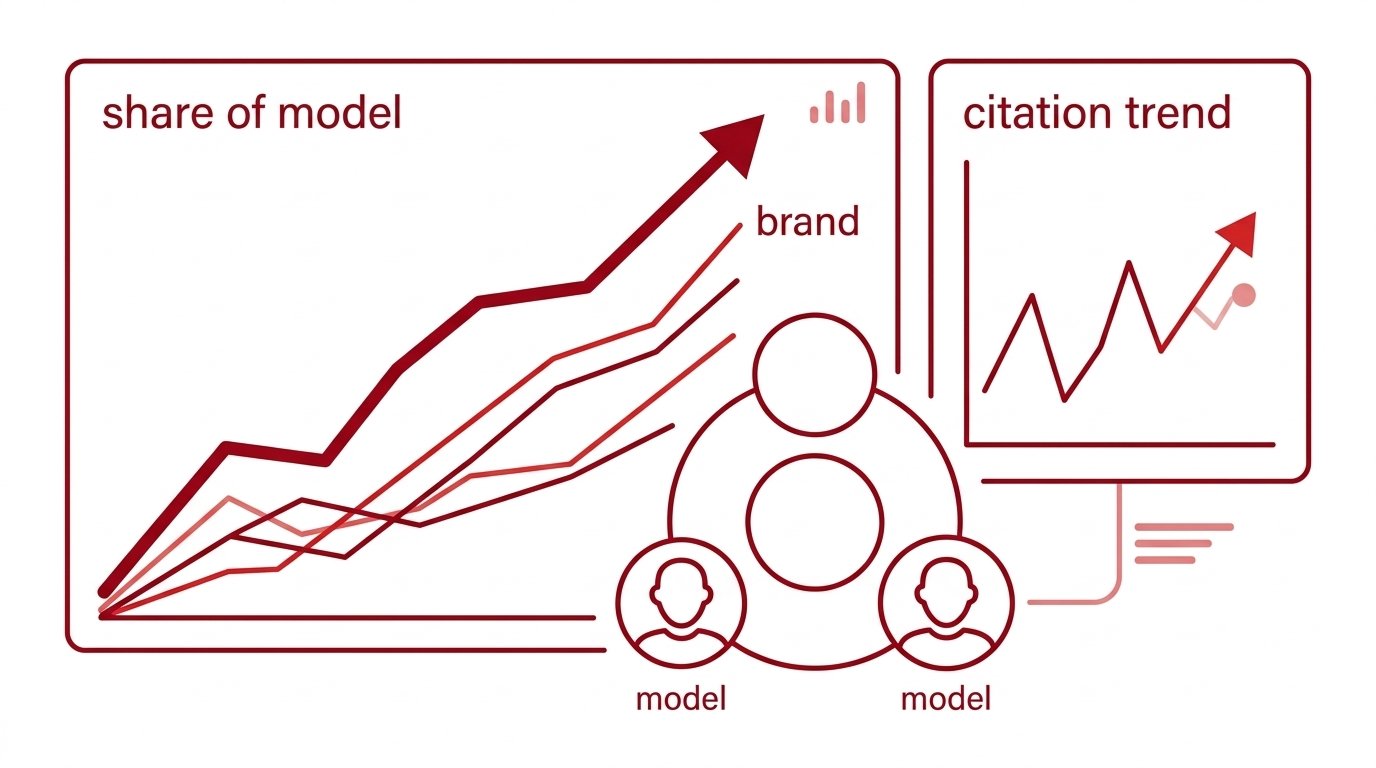
Share of model is your brand's mentions as a proportion of all brand mentions in AI-generated answers, measured across a defined prompt set, a defined competitive universe, and a defined platform set. It answers the question a rank report never could: when an AI agent names vendors in our category, how often is one of them us?
How the number is actually computed
Profound's published formula divides runs mentioning your brand by runs mentioning any brand, computed separately for each AI model, then averaged across models with equal weight. A model that mentioned competitors but not you counts as a zero, and runs where no brand appeared are excluded from both sides of the fraction[4]. That per-model discipline matters, because pooling everything together would let one high-volume model drown out the rest and flatten your number.
The same idea, the IAB's name
The IAB frames this as Share of Voice: brand mentions as a proportion of all brand mentions within a defined competitive category, with the explicit note that a brand's absolute mention rate matters less than its relative share[3].
| Framing | Formula | Question it answers |
|---|---|---|
| Share of model (per-model runs) | Runs mentioning your brand divided by runs mentioning any brand, computed per model, then averaged with equal weight[4] | Of the answers that name anyone, how often is it us? |
| Share of Voice (IAB) | Brand mentions as a proportion of all brand mentions in a defined competitive category[3] | How much of the category conversation do we own? |
Before you benchmark anything, fix the inputs, because they determine the number:
- The prompt set: the real questions your buyers ask, written the way they ask them.
- The competitor set: which brands count as your category, and on what basis.
- The platform set: which AI engines you measure, and how often you re-run them.
How to track AI citations without fooling yourself
A mention and a citation are different events, and the IAB's shared vocabulary keeps them separate. A mention names your brand in the answer. A citation links your domain or names it as a source. Where Mention Rate captures whether a brand is spoken about, Citation Rate captures whether the brand is relied on, the degree to which AI platforms treat your content as an authoritative reference[3].
The gap between the two is itself a signal. A high mention rate with a low citation rate tells you the platforms talk about you but don't treat your domain as a source worth naming. Closing that gap is an authority problem before it is a measurement problem, the difference between being discussed and becoming a trusted voice.
AI responses are also probabilistic, so single prompts prove nothing. Ahrefs' analysis of 1.4 million ChatGPT prompts found that only about half of retrieved URLs end up cited, and Reddit pages, retrieved at massive scale, were cited just 1.93% of the time[5]. Retrieval is not citation, and one run is not a trend. Four habits keep citation tracking honest:
- Run a fixed prompt set large enough to absorb run-to-run randomness, and re-run it on a fixed cadence.
- Track mentions and citations as separate metrics, and read the gap between them deliberately.
- Ask your provider whether trend data is re-baselined after model updates, because the IAB warns visibility momentum is vulnerable to platform changes that shift baselines independent of brand performance[6].
- Treat any score change as methodology drift until you have confirmed the prompt set, model mix, and platform coverage did not move underneath it.
AEO analytics: choosing tools that give decision-grade data
More than 20 companies now sell AI visibility measurement tools, each using different methodologies that can produce different answers for the same brand[6]. That is the market condition, not a knock on any vendor. The practical question for a marketing leader is which tier of data a tool actually delivers, because the IAB separates measurement into two quality tiers: directional data for trend spotting, early signals, and internal briefings, and decision-grade data fit for budget allocation, agency performance reviews, and executive strategy[3].
The rigor criteria that separate the tiers are concrete, and any serious provider should be able to answer to all of them:
- Sample size and query volume behind every reported number.
- Prompt type coverage, not just a handful of branded queries.
- Testing cadence, on a schedule you can hold them to.
- Reproducibility, meaning the same inputs produce the same outputs.
- Methodology documentation you can actually read.
- Multi-platform aggregation across the engines your buyers use.
Questions to ask before the number reaches a board deck
- How many prompts run per model per period, and can I see the list?
- Which models and platforms are covered, and how are they weighted?
- What is your citation definition, linked reference or named reference?
- How do you handle model updates that shift the baseline?
Keep one boundary clear while you evaluate: these platforms measure the answer layer, what AI agents say about you. Your GA4 and CRM measure what humans do afterward. You need both halves, and the next section covers how to join them.
From visibility to pipeline: GA4 AI referrals and self-attribution
Visibility metrics are leading indicators, and leadership eventually asks the lagging question: what did this do to pipeline? The first half of the answer lives in GA4, which can track sessions and conversions from AI assistants such as ChatGPT, Gemini, Perplexity, Copilot, and Claude when referral data is available, and you can follow those sessions through to booked meetings[7].
Treat referral data as the floor, not the ceiling. Zero-click answers hide most AI-influenced journeys: the buyer hears the recommendation, types your URL directly, and shows up in your analytics as direct traffic. Referral reporting will always undercount the channel it measures.
Self-attribution closes that gap. On Cited Conversations[8], Casey Cheshire argues the only valid metric is revenue from people finding you in AI, checked in Google Analytics against clicks coming directly through AI chatbots and AI overviews, then followed to booked meetings or purchases. His second mechanism is refreshingly low-tech: a simple where-did-you-find-us field on the booking form. The working loop looks like this:
- Tag AI referral sources in GA4 and trend their sessions and conversions monthly.
- Follow AI-referred sessions to the meetings and opportunities they create in your CRM.
- Add a where-did-you-find-us field to your booking form and log the AI answers by name.
- Reconcile the self-reported answers against your visibility trend each quarter.
Building the board-ready AI visibility report
The IAB organizes AI visibility metrics into a causal hierarchy, the 4 P's, that reflects how visibility translates into business value[3]. Structure your report the same way and the board can follow the logic from presence to revenue without a translation layer:
| P | Core question | Metrics |
|---|---|---|
| Presence | Does the brand appear? | Mention rate, citation rate, share of voice, visibility momentum |
| Prominence | Where and how prominently? | Position in the answer |
| Portrayal | In what context, and with what accuracy? | Sentiment, framing, hallucination rate, factual inaccuracy rate |
| Persuasion | Does visibility drive action? | Recommendation strength, post-citation CTR |
Two dashboard views carry most of the weight in practice. An executive overview tracks AI referral traffic, share of voice, citations, competitor visibility, and assisted conversions. A business impact view ties AI-assisted conversions, AI referral conversion rate, and pipeline influenced by AI referrals back to the visibility trend[7].
Cadence is what makes the report mean anything. Hold the prompt set unchanged, re-run on a fixed monthly schedule, and let month-over-month movement reflect the market rather than your methodology. Then present the two clocks honestly: visibility metrics move first and revenue evidence lags behind them, so ask the visibility trend to predict, and ask the pipeline data to confirm, never both in the same quarter.
What feeds measurable visibility: expert content capture
Every metric above is downstream of one input: the quality of what AI agents can read about you. AI search engines don't listen to audio, they read text, so a podcast contributes to visibility only through its text derivatives: transcripts, episode pages, Q&A breakdowns, and structured show notes. The capture and transformation process matters as much as the recording itself.
Structure compounds. Every guest brings an entity association, and when a credible operator from a relevant company appears in your content, AI search engines connect your company to that person, that company, and that topic. That is why strategic guest sourcing from your ICP, rather than random industry voices, is what turns each conversation into authority signals and why ICP-fit guests are one of the core pillars of a podcast that actually drives demand.
The raw material usually already exists inside the company. Simon Wilhelm, Co-Founder and CEO of SCAILE, points to the Mittelstand companies that dominate German industry: decades of unique knowledge, locked in spreadsheets, old books, and inaccessible databases. His framing is the right test for any B2B team: the question is not only whether your content is AI-ready, but whether your knowledge is. Scaling that knowledge capture out of your experts' heads is a real operational bottleneck, and treating it as a system rather than a scramble is what makes it repeatable.
That is the loop this article closes. Ringmaster exists as the front-end content capture engine: we design and capture structured, human-sourced expert conversations, then hand the entity-rich text derivatives to your AEO partners, whose results you measure with the stack above. A managed program keeps that cadence of expert conversations flowing week after week, so the visibility trend in your board report has something real underneath it. Measure honestly, feed the agents content worth citing, and the metrics stop being vanity and start being evidence.
Frequently asked questions
What is share of model in AI search visibility?
Share of model is your brand's mentions as a proportion of all brand mentions in AI-generated answers, measured across a defined prompt set, competitor set, and platform set. Tools such as Profound compute it per model (runs mentioning your brand divided by runs mentioning any brand) and then average across models. Because the number depends entirely on the prompt and competitor sets you define, fix those first and keep them constant so month-over-month movement means something.
How is an AI citation different from a mention?
A mention is your brand's name appearing in an AI-generated response. A citation is a linked or named reference that credits your domain as a source, the distinction the IAB's measurement framework codifies. A brand can have a high mention rate and a low citation rate, and that gap is itself a signal: it shows whether AI platforms talk about you or actually rely on your content. Track the two separately rather than blending them into one score.
Which tools track brand visibility in AI search?
More than 20 companies now sell AI visibility measurement tools, including standalone platforms and add-ons inside SEO suites, and each uses a different methodology that can produce different answers for the same brand. The IAB separates directional data, useful for spotting trends, from decision-grade data that meets thresholds for sample size, prompt coverage, cadence, reproducibility, and multi-platform aggregation. Ask any vendor those questions before their number reaches a board deck.
Can Google Analytics track traffic from ChatGPT and other AI assistants?
Yes, with limits. GA4 can capture sessions, users, and conversions from AI assistants such as ChatGPT, Gemini, Perplexity, Copilot, and Claude when referral data is available, and you can follow those sessions through to booked meetings. Treat referral data as the floor rather than the total, because zero-click answers satisfy many queries before any click happens and stripped referrers hide more journeys.
How do I prove AI visibility ROI to my CEO or board?
Pair a leading indicator with a lagging one. Report share of model and citation rate on a fixed prompt set as the trend, then connect it to outcomes: GA4 conversions from AI referrals, and self-attribution via a where-did-you-find-us field on your booking form. Casey Cheshire, Founder & CEO of Ringmaster, argues on Cited Conversations that the only valid metric is how much more revenue came from people finding you in AI, and that self-attribution is how B2B teams capture it.
How often should B2B teams measure AI visibility?
On a fixed monthly cadence with an unchanged prompt set. AI responses are probabilistic, so the same prompt can produce different brands and citations each run, which means single prompts prove nothing. Ahrefs' analysis of 1.4 million ChatGPT prompts, reported by Search Engine Journal, shows how differently retrieval and citation behave at scale. Large, consistent prompt sets across models turn that noise into a trend you can act on.
Do podcast downloads matter for AI visibility?
No. AI search engines do not listen to audio; they read text. A podcast contributes to AI visibility only through its text derivatives: transcripts, Q&A breakdowns, structured show notes, and episode pages. That is why the capture and transformation process matters as much as the recording, and why a content capture engine that turns expert conversations into structured, entity-rich text is the input side of any AI visibility measurement program.