
Why Human Expertise Is the New Input for AI Search
Put this at the top of your planning doc: your buyers stopped Googling first. G2 surveyed 1,076 B2B software buyers in March 2026 and found that 51% now start their research with an AI chatbot more often than with Google, up from 29% the year before[1]. Even more striking, 69% of buyers chose a different vendor than they initially planned, simply because that vendor showed up in the chatbot's recommendation[1]. The first impression of your brand is increasingly formed by what an AI agent says about you, not by your website or your sales team.
This is zero-click research in its purest form. Buyers aren't asking AI agents for a list of links to browse. They're asking for an answer, and the engines respond with names: companies, people, frameworks. If your experts aren't among the sources an agent can find and cite, you don't exist in that conversation. And no, scaling up AI-generated blog posts won't close the gap. Commodity content is exactly what AI agents already know how to generate on their own, so it gives them no reason to cite you. The scarce input is the thing only your company has: real humans with real frontline experience.
- The knowledge gap: your subject matter experts hold insights AI agents can't find anywhere, because most of that expertise lives in conversations, calls, and heads, not in indexed pages.
- The differentiation gap: AI-generated content recycles what machines already know, so it can't make your company the cited source on the topics your ICP-fit buyers are asking about.
- The trust gap: buyers treat an AI mention as validation, which means being absent from the answer is the same as being absent from the shortlist.
The raw material is already inside your company. The work is bridging it: capturing what your experts actually know and structuring it so AI agents can retrieve, understand, and cite it. That bridge is what the rest of this guide builds, step by step. For a deeper dive on the mechanics, this practical guide to feeding AI agents with B2B podcasting pairs well with what follows.
The Human to AI Framework: From Conversation to Citable Asset
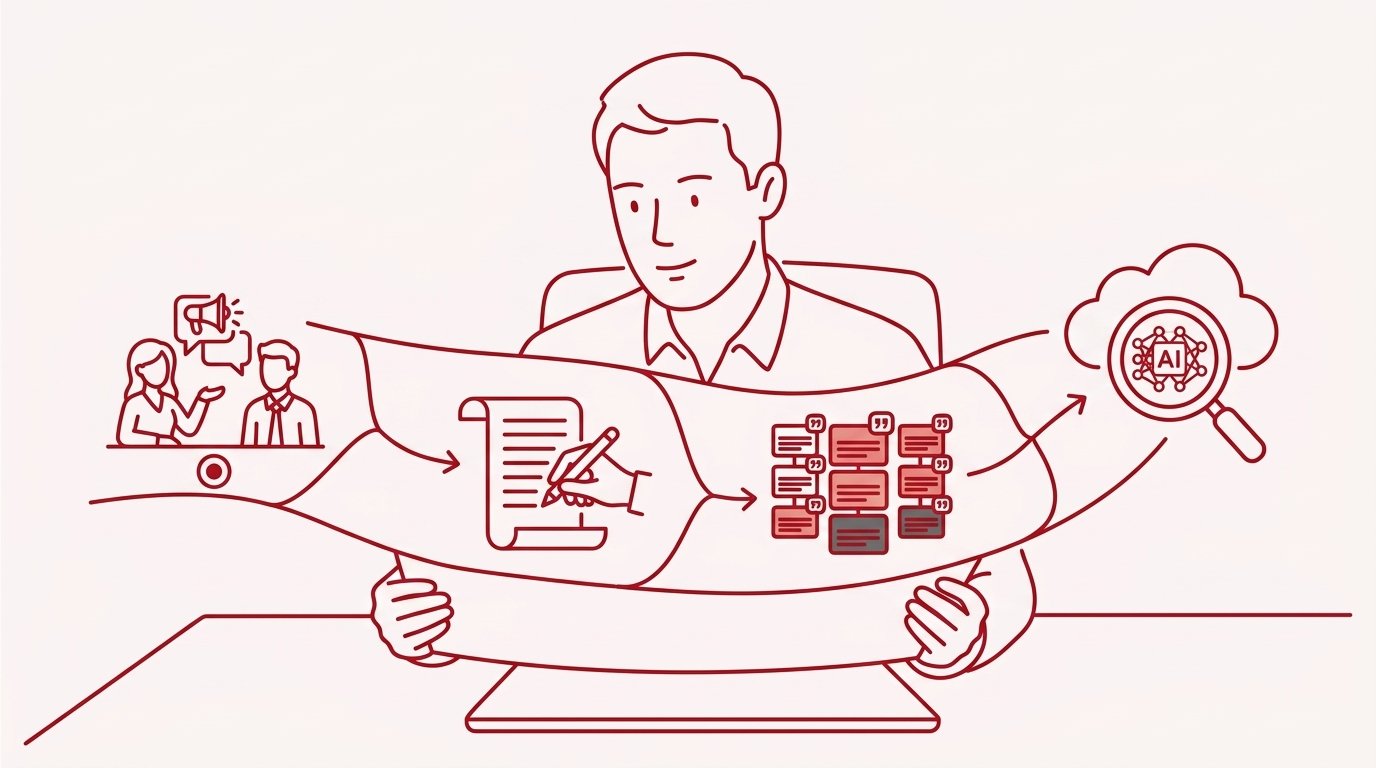
Think of human-to-AI content as an operating model with three stages, not a one-off campaign. The Plan, Capture, Transform (PCT) Framework designs questions around AI visibility gaps, captures structured expert dialogue, and transforms each conversation into a library of content assets answer engines can index and cite. Each stage does a different job:
- Plan: start with a stated outcomes document. Which topics, questions, and entities does your company need to own in AI search? Design the question set around those gaps before anyone books a guest, so the prep going in matters as much as the optimization coming out.
- Capture: record a structured expert conversation against a recording brief. Two named humans, on the record, answering real questions. The conversation is the capture mechanism, not the end product.
- Transform: turn the messy dialogue into structured answer assets: Q&A blocks, definition pages, comparison tables, and step-by-step guides that an AI agent can parse and cite.
Why planning is the 80/20 lever
The research backs the front-loading. The foundational GEO study from KDD 2024 tested which content changes make a source more likely to be cited in AI-generated answers, and found that methods like adding citations, quotations, and statistics can boost visibility in generative engine responses by up to 40%[2]. Notice what those methods have in common: they all depend on having real, attributable material to work with. You can't add an expert quotation or a proprietary statistic to content that never captured one. Planning the question set around your visibility gaps is what makes the transform stage possible.
It also changes what a single conversation is worth. Casey Cheshire, Founder & CEO of Ringmaster, estimated in Episode 1 of Cited Conversations that one 45-minute expert conversation per week, built on great questions, yields more structured AI-visible content than a full-time content writer delivers in a month, and that it comes with real human attribution the AI engines are going to trust more. The lever is the question set: lazy questions yield raw chatter, while a well-planned one yields a quarter of answer-ready material.
The AI Content Engine: Repeatable Inputs, Compounding Outputs
Stop treating each expert conversation as a one-off and start treating it as an input. One weekly conversation feeds a compounding library rather than a single publish-and-pray asset. The output math looks like this:
- Q&A blocks that answer the specific, high-intent questions buyers type into ChatGPT, Perplexity, and Gemini.
- Definition pages that establish your experts as the source for the terms your market uses.
- Comparison tables that give agents concrete, citable figures instead of vague adjectives.
- Step-by-step guides built from the way your practitioners actually solve the problem.
- A hub page with schema markup that ties the whole library together so engines can parse the structure, not just the text.
The teams seeing real results treat these as repeatable inputs, not creative sparks. ABI Research found that the most effective AEO programs are built around exactly this rhythm: B2B sales questions, webinar Q&As, SME insight, and original research giving marketing teams a steady stream of content that answer engines can cite[3]. Your demand gen machine already captures these inputs every week; the engine just makes the capture deliberate.
It helps to run two parallel tracks from the same capture. The human-facing track is the derivatives your audience loves: clips, quotes, newsletter pull-outs, the conversation itself. The machine-facing track is the structure: clean Q&A pairs, entity-rich summaries, and markup that agents can index. Same conversation, two audiences. The human track builds relationships and credibility; the machine track builds citability. Neither works as well without the other.
Structured Knowledge Capture: Turning Messy Dialogue Into Data
So what does structured actually mean? A one-hour transcript is not structure; it's a wall of text that an AI agent has to work too hard to trust. Structure is the difference between content that gets cited and content that gets skipped. Three components do the heavy lifting:
- Q&A blocks: each exchange broken into a discrete question and a self-contained answer, so an engine can lift the exact passage that answers a buyer's query.
- Schema markup: machine-readable labels (Article, FAQ, Person) that tell agents who said what, what the page covers, and why it deserves trust.
- An evidence ledger: the receipts proving that named, verifiable experts actually said these things, with attribution intact. This is what separates human-sourced content from the AI-generated flood engines are getting pickier about.
Entity associations: the quiet multiplier
Every guest brings an entity association, as Casey put it in the same Cited Conversations episode. When a credible expert from a known company appears in your conversation, AI search engines connect your company to that person, to that company, and to that topic. That's why strategic guest sourcing matters: every conversation should be with someone your company actually wants to build relationships with, not random industry voices. Each ICP-fit guest weaves your brand deeper into the authority map AI agents construct.
Two practical realities shape what engines can actually use. First, as Simon Wilhelm, Co-Founder & CEO of SCAILE, explained in Episode 2 of Cited Conversations, many can't parse JavaScript, so content rendered client-side in widgets and dynamic loaders is invisible to them; clean HTML is the price of entry. Second, engines cite what humans engage with: an analysis of 30 million sources across ChatGPT, Google AI Mode, Gemini, Perplexity, and AI Overviews found Reddit, YouTube, and LinkedIn top the most-cited domains[4]. And Google's own guidance points the same direction: its ranking systems reward original, high-quality content that demonstrates experience, expertise, authoritativeness, and trustworthiness, rather than pages that restate what a model could generate[5]. Real expert dialogue, structured properly, is the hardest content in the world to fake.
B2B Content Operations: Running the Workflow Week to Week
Frameworks don't build libraries; operations do. The difference between a program that compounds and a podcast that fades is a weekly cadence with clear roles and clean hand-offs. The cadence runs like this:
- Plan the question set: pull from sales call objections, webinar Q&As, and your AI visibility gap list. Pick the questions buyers are actually asking agents this week.
- Brief the guest: share the question set, the outcomes document, and why their entity association matters. A briefed guest gives you quotable, structured answers instead of warm-up chatter.
- Capture the conversation: record against the brief, with consent and attribution locked in from the start.
- Transform into assets: cut the dialogue into Q&A blocks, definitions, comparisons, and guides, and apply schema markup before anything ships.
- Publish and distribute: push human-facing derivatives to your channels, feed the structured layer to your site, and get both in front of the communities where your buyers already hang out.
Notice who this empowers rather than replaces. Your existing content team doesn't disappear; they plug in as editors and distributors, doing what they're great at with far better raw material than a blank page. Real expert dialogue gives them original perspectives, entity associations, and quotes that can't be generated by AI, and their work becomes more powerful with it, not less.
One more operational truth: consistency beats bursts. ABI Research is blunt about this: AI-driven search results are highly dynamic, changing continuously as new viewpoints surface, and a short-term approach won't cut it[3]. A three-conversation sprint then silence teaches the engines nothing durable. A weekly rhythm, sustained, is what keeps your experts in the answer. This always-on logic is the same reason media-driven marketing works for ABM in the first place.
Measuring What Matters: Visibility, Not Downloads
Let's set the scoreboard straight, because this is where most programs talk themselves out of a good strategy. If the content's job is to be cited by AI agents, then download counts and listen numbers are vanity metrics measuring the wrong audience. The scoreboard is AI visibility and entity presence:
- Are your experts and your company showing up in AI answers for your target topics? Ask the questions your buyers ask, across ChatGPT, Perplexity, and Gemini, and track who gets named.
- Is your entity footprint growing? Are you connected to more topics, more credible people, and more specific questions this quarter than last?
- Are AI referrals showing up in your analytics, and do those visitors behave like engaged buyers rather than drive-by traffic?
For a real-world benchmark, ABI Research attributes its own AI referral traffic growth over 10 months to precisely the playbook in this guide: Q&A formatted articles answered by technology experts, detailed author bylines, and JSON schema markup on every piece[3]. That's what the machine-facing track delivers when it's run consistently.
And the content library is only half the return. Strategic guest conversations build durable relationships with ICP-fit peers, and that give-first dynamic, sharing your platform and your audience, is the opposite of the take-focused outreach your buyers have gone numb to. Credibility content like this is how brands become a trusted voice in their market. Build credibility while the library does its quiet work.
Getting Started: Your First 90 Days of Human-Sourced Content
You don't need a budget line and a steering committee to start this. You need 90 days and a willingness to treat your experts as the input they already are. The first 90 days look like this:
- Days 1 to 30, audit: ask the questions your buyers ask. Type them into ChatGPT, Perplexity, and Gemini and record who shows up and who doesn't. That gap list is your opportunity map.
- Days 1 to 30, pick three topics: choose the first three questions your experts should own, the ones where your frontline experience beats anything a model could generate.
- Days 31 to 60, pilot: run your first structured expert conversations against a recording brief. Plan the question set, capture, and transform each one into Q&A blocks and schema-marked pages.
- Days 61 to 90, systematize: lock the weekly cadence, assign the editorial roles, and start tracking AI visibility for your target topics.
Around day 60, ask an honest question: who is doing the heavy lifting? Capturing, editing, structuring, recruiting guests, and coordinating logistics is a real operational load, and it's exactly the load a production partner should carry so your team stays focused on strategy and the guest relationship. Tiers like Ringmaster Prestige, with daily community engagement, high-volume promo clips, and monthly hosted roundtables, and Ringmaster Community Roundtable, which handles member recruitment, event coordination, and guest speakers, exist for precisely this logistics layer. The point is partnership, not outsourcing: you bring the expertise and the relationships, the partner handles the machinery.
Finally, keep the division of labor clean. Captured, structured content hands off cleanly to your AEO partners for optimization; the capture engine is the front end of the AI visibility pipeline, not the optimization layer. Human expertise in, structured assets out, and your AEO partner takes it from there. The model comes down to real conversations, captured deliberately, structured for the agents your buyers now ask first. The expertise is already in your building. All that's left is to stop letting it stay invisible.
Frequently asked questions
What is a human to AI content workflow?
It is the operating model where human-sourced expertise, usually captured in structured expert conversations, is transformed into machine-readable content assets that AI agents can find, trust and cite. The workflow runs in three stages: plan the questions around AI visibility gaps, capture the conversation, and transform it into structured, schema-marked assets.
Why does AI-generated content not work for AI visibility?
AI engines synthesize answers from many sources, so content that merely restates what a model could generate itself adds nothing. Google's own guidance says unique, non-commodity content with a first-hand perspective is what performs in AI search features. Real expert dialogue, proprietary data and named human attribution are signals a model cannot fabricate.
What content formats do AI search engines cite most?
Fresh, structured, human-voiced sources dominate AI citations, which is why community platforms and expert-authored domains surface so often. For your own site, Q&A formatted pages, expert bylines, HTML tables and schema markup make content easier for engines to parse and cite.
Do I need a podcast to feed AI engines?
No, but a structured expert conversation is the most efficient capture mechanism, because a single well-planned session yields a whole library of answer-ready assets from one capture. Webinars, sales Q&As and structured expert conversations work too, as long as the output is transformed into machine-readable structure rather than left as raw audio or transcript.
How long does it take to see AI visibility results?
Programs are measured in months, not days. AI search results stay dynamic as new viewpoints surface, so consistency matters more than a one-off push. Track whether your experts and company appear in AI answers for your target topics as the scoreboard.
How is this different from SEO?
SEO optimized pages to rank in a list of links. This workflow optimizes expertise to be cited inside a synthesized answer. The mechanics overlap, since crawlers still need to find and parse your pages, but the goal shifts from rankings to visibility: being the named source an AI agent quotes when a buyer asks a question in your category.
Should our content team be replaced by this workflow?
No, the team becomes more powerful. Captured expert conversations give your writers raw material that cannot be generated by AI, and the team plugs in as editors, distributors and analysts of the structured output. The capture engine handles the heavy lifting of production logistics while your people focus on strategy and the relationships.