
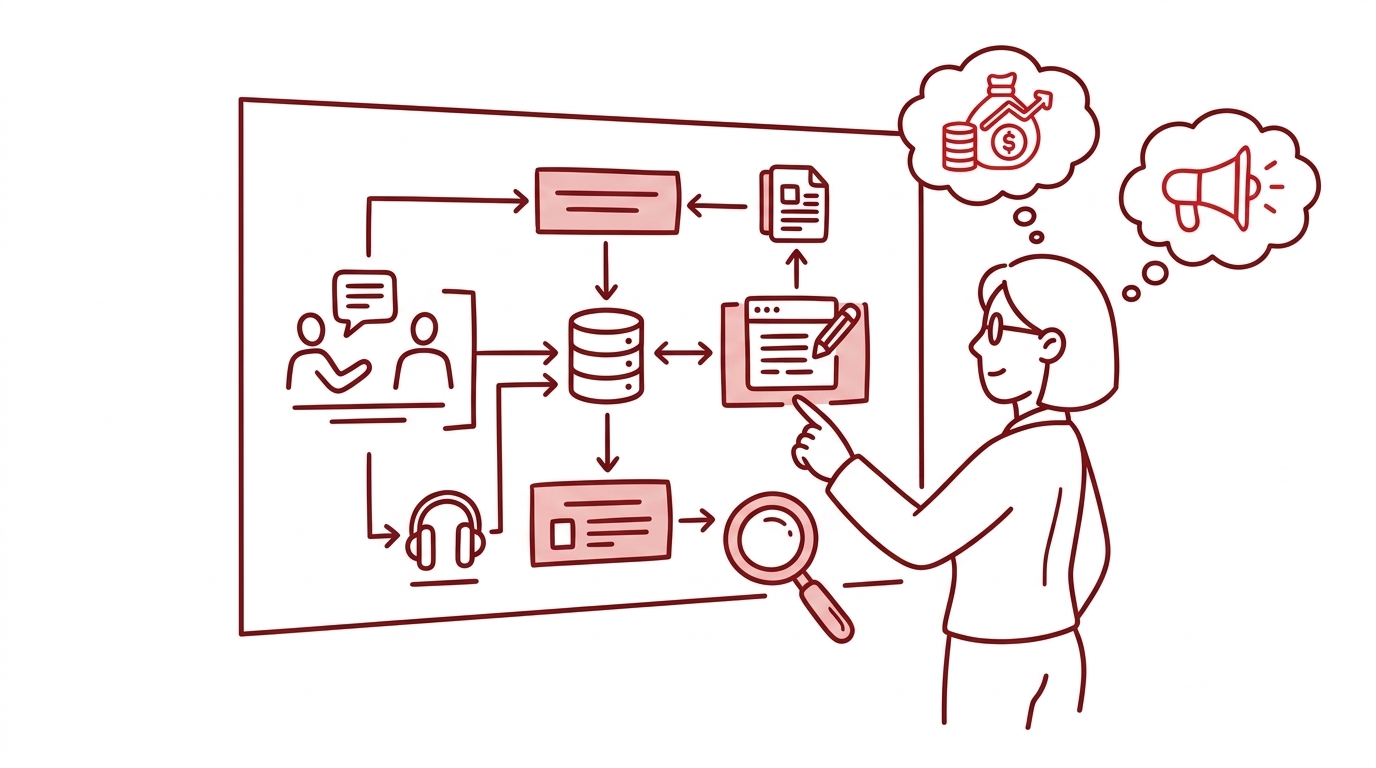
Your company is sitting on expertise that would make your competitors nervous. The problem? Most of it lives in your CEO's head, in the margins of sales calls, in conference hallway conversations that nobody recorded. It's real, it's valuable, and it's completely invisible to the buyers who need it most.
This is the gap between tacit and documented knowledge. Tacit knowledge is the judgment calls, the edge cases, the "watch out for this" instincts an expert builds over a decade. Documented knowledge is what actually survives: the slide deck, the SOP, the one-pager. The gap between the two is where companies lose their edge, because the moment an expert walks out the door, the tacit half walks with them.
That risk isn't hypothetical. In manufacturing, where this problem has been studied longest, roughly half of maintenance and reliability professionals will reach retirement age within the next decade, and much of what they know exists only in their own experience rather than in any structured system[1]. B2B companies face the same math with their own experts: the knowledge that isn't captured in a repeatable format is knowledge the company doesn't really own.
Here's why this matters more now than it did two years ago: your buyers have changed where they look. Forrester's Buyers' Journey Survey of nearly 18,000 global business buyers found that 94 percent used AI during their buying process, and that they lean on it for speed and breadth before validating what it tells them with peers and product experts[2]. The shortlist is forming inside a chat window, not on your website.
Put those two facts together and you get the core operational problem: the expertise that could win you a place on that shortlist is uncaptured, and uncaptured expertise is invisible exactly where buyers are now deciding. This isn't a content problem. It's a knowledge extraction problem, and it needs a system, not another brainstorm.
- Tacit knowledge: judgment calls, edge cases, and instincts that live in an expert's head
- Documented knowledge: SOPs, decks, and one-pagers that survive a departure
- The gap: expertise that exists but is never structured, published, or visible to buyers or AI engines
Expert Extraction at Scale: The In-House Bottleneck
Most teams don't fail at capturing expert knowledge because they lack ideas. They fail because the work around each conversation is heavier than anyone expects, and the person doing that work is usually already doing three other jobs.
A single expert conversation carries 15 to 25 hours of surrounding work: pre-production planning, guest research and outreach, technical setup, editing, graphics, show notes, and social clip creation[3]. That's not the conversation itself. That's everything wrapped around it, and it's the reason in-house extraction stalls as volume grows.
Layer on the reality that your subject matter experts are already overburdened, and access becomes the chronic bottleneck. In CMI's annual B2B research, 33 percent of marketers still cite accessing subject matter experts as a challenge, even as that figure improved from 39 percent the year before[4]. Your best experts are also your busiest people, and "can I grab 30 minutes Thursday?" is the first thing that slips when a launch or a quarter-end looms.
The result is a momentum problem, not a talent problem. When capture is episodic, something a marketer squeezes in between campaigns, output slips just as demand for content grows. Episodes get delayed, quality drops, and the whole effort reads internally as "that podcast thing we tried" rather than a system the business can rely on.
- Pre-production planning and guest research: 5 to 8 hours per conversation
- Technical setup, recording coordination, and editing: 6 to 9 hours
- Graphics, show notes, blog support, and social clips: 6 to 10 hours
- Total: 15 to 25 hours of surrounding work per single expert conversation
SME Knowledge Management: From One-Off Interviews to a System
The fix isn't working harder at the same ad hoc approach. It's shifting the mindset from "let's grab an interview when we can" to governed, repeatable capture that runs whether or not anyone's chasing it that week.
Start with what you're actually trying to capture. Written notes and generic question lists consistently miss the judgment calls, edge cases, and decision rules that make expert knowledge valuable in the first place. The useful distinction is between explicit knowledge (policies, SOPs, diagrams) and tacit knowledge (the "watch out for this" context that sits in someone's head). Capture only the explicit half and you get handovers that look complete on paper but fall short the first time something unusual happens.
That reframes capture as a core operational control, not a last-minute rescue before someone resigns. If you only extract knowledge when a departure forces the issue, you're rebuilding confidence and processes every time a key person changes seat. Baking capture into business-as-usual, on a cadence, with named ownership, is what turns it from a fire drill into infrastructure.
The output has to be structured enough that other teams can actually reuse it. A raw recording isn't a system. A transcript, a Q&A breakdown, a set of escalation rules, and a short list of edge cases: those are artifacts a sales enablement lead, a new hire, or an AEO partner can pick up and use without a briefing call.
- Capture the happy path: what good looks like, step by step
- Capture the edge cases: what commonly goes wrong and how to fix it
- Capture the decision rules: "if X happens, always check Y before Z"
- Capture the escalation pathways: triggers, contacts, and scope, not just names
Scaling Content Operations Around a Capture Engine
Once capture is systematic, it stops being a content task and starts being a content input. That distinction is what makes the model scale.
The scale problem is real and measurable. CMI's 2025 benchmarks found that 45 percent of B2B marketers lack a scalable model for content creation, and 37 percent call content repurposing a challenge[4]. Those two numbers are the same problem wearing different clothes: teams are producing content one piece at a time, by hand, with no repeatable input to multiply.
A capture engine changes the input. One 45-minute expert conversation becomes a full library of derivatives: a clean transcript, a Q&A breakdown, entity-rich articles, social clips, and short-form assets. The conversation is the raw material; the system around it determines how much usable content comes out the other side.
This is also what removes the blank-page problem that stalls small content teams. A writer staring at an empty doc has to invent structure, angle, and authority from scratch. A writer working from a transcript of a real expert conversation starts with substance, quotes, and a clear point of view already on the page. Same team, same headcount, radically different output.
- 45% of B2B marketers lack a scalable model for content creation (CMI 2025)
- 37% call content repurposing a challenge (CMI 2025)
- One 45-minute expert conversation yields transcripts, Q&A breakdowns, entity-rich articles, and social clips
- The capture step replaces the blank page with real expert substance
B2B Knowledge Extraction: The Operational Cost Comparison
Now the money question: what does each approach actually cost to run? Not just in salary and software, but in the time it pulls away from work that generates revenue.
In-house extraction stacks several cost lines against inconsistent output: salaries or partial allocations for whoever runs the program, tooling for recording and editing, and the training curve to get quality up to standard. None of those are wasted spend exactly, but they're variable, they scale with effort rather than with results, and they compete with every other priority on the marketing team's plate.
The hidden cost is opportunity cost. Using the 15 to 25 hours of surrounding work per conversation from the APodcastGeek breakdown, a bi-weekly cadence pulls 30 to 50 hours a month out of expert and marketer time, hours that aren't going into demand gen, sales support, or pipeline work[3]. That's the real price of DIY extraction, and it rarely shows up on a budget line.
A dedicated capture engine replaces that variable internal drain with a fixed monthly engagement and a consistent cadence. The spend becomes predictable, the output stops depending on whose quarter is busiest, and your experts' time gets capped at the conversation itself instead of the 20 hours of logistics wrapped around it.
| Cost factor | In-house extraction | Dedicated capture engine |
|---|---|---|
| Expert time per conversation | Conversation plus 15-25 hours of surrounding work | Conversation only |
| Marketer time per conversation | Pulled from demand gen and pipeline work | Minimal, coordination only |
| Cost structure | Variable: salaries, tools, training | Fixed monthly engagement |
| Output consistency | Slips when internal priorities spike | Consistent cadence, independent of internal workload |
Decision Criteria: When In-House Works and When to Partner
Neither approach is right for every team at every stage. The honest answer is that in-house extraction makes sense in specific situations, and a dedicated capture engine makes sense in others. Here's how to tell which side of the line you're on.
In-house works when you have dedicated production staff whose full-time job is this, when you're still experimenting with format and cadence, or when your publishing schedule is genuinely irregular, a few conversations a year rather than a weekly rhythm[3]. In those cases, the fixed cost of a partner isn't justified yet, and the learning curve is worth the investment.
A dedicated capture engine makes sense once you're operating at consistent weekly cadence, pulling expertise from multiple experts across different teams, and producing output that needs to feed an AI visibility strategy rather than just fill a content calendar. At that point, the logistics volume has outgrown what a shared internal role can absorb without dropping other work.
Score yourself against this checklist before you commit either way.
- Do you have dedicated production staff, or is this a shared role wearing another hat?
- Is your cadence consistent and weekly, or irregular and experimental?
- Are you pulling expertise from one expert or from multiple SMEs across teams?
- Does the output need to feed an AI visibility or AEO strategy, or just a content calendar?
- Can your team absorb 15 to 25 hours of surrounding work per conversation without dropping revenue work?
What Happens to Captured Expertise After the Recording
Here's where the whole system pays off. Captured expertise doesn't just live in a content library. It becomes visibility in the places buyers actually look now, which is increasingly inside an AI answer rather than a search result page.
The transformation step matters as much as the recording itself. AI engines read text derivatives, transcripts, Q&A breakdowns, entity-rich articles, not raw audio. A great conversation that never gets turned into structured, machine-readable content is invisible to the systems assembling buyer shortlists. The capture step and the transformation step are two halves of the same pipeline.
The buyer behavior data makes this urgent rather than theoretical. G2 research reported via Demand Gen Report found that 51 percent of B2B software buyers now start their research in an AI chatbot rather than a traditional search engine, and that AI chatbots are the top source influencing which vendors make the shortlist[5]. If your expertise isn't structured and visible to those engines, it isn't part of that conversation.
This is where the operating model matters more than the tooling. A dedicated capture engine sits at the front of the pipeline: designing and running the expert conversations, then producing the entity-rich derivatives (transcripts, Q&A breakdowns, articles) that downstream teams optimise and distribute. You keep the strategy and the conversation. The repeatable logistics of capture and transformation sit with whoever is set up to run them on a cadence.
That division of labor is the whole point. Your experts stay focused on sharing what they know. Your marketing team stays focused on strategy and distribution. The capture engine handles the logistics of turning human expertise into structured, reusable content. And your AEO partner takes it the last mile into AI search visibility. Each piece does what it's best at, and the system compounds instead of stalling.
- AI engines read text derivatives, not raw audio, so transformation matters as much as recording
- AI chatbots are now the top source influencing which vendors make a buyer's shortlist (G2 via Demand Gen Report)
- 51% of B2B software buyers start research in an AI chatbot rather than a search engine[5]
- Capture engine feeds structured, entity-rich content to your AEO partner; you own strategy and the conversation
Frequently asked questions
What is subject matter expert knowledge capture?
It is the systematic process of extracting expertise from the people who hold it, through structured expert conversations, and transforming those conversations into reusable assets: transcripts, Q&A breakdowns, articles, and clips. The goal is a repeatable capture system rather than one-off interviews, so expertise becomes structured, published, and visible to both buyers and AI search engines.
Why is SME knowledge so hard to capture at scale?
Because the most valuable knowledge is tacit: judgment calls, edge cases, and decision rules that never make it into documentation. Experts are also overburdened, and access to them is a chronic content challenge. In-house extraction typically demands 15-25 hours of surrounding work per conversation, from research and scheduling to editing and derivatives, so capture stays episodic instead of systematic.
How much time does in-house expert content production really take?
Industry breakdowns put a single expert conversation at 15-25 hours of total production work: pre-production planning, guest research and outreach, technical setup, editing, graphics, show notes, and social clips. At a bi-weekly cadence that is 30-50 hours a month pulled from marketers and experts whose time is better spent on strategy and the conversation itself.
Should we capture expert knowledge in-house or use a dedicated capture engine?
In-house works when you have dedicated production staff, are still experimenting with format, or publish irregularly. A dedicated capture engine makes sense when you need a consistent weekly cadence, multiple experts across teams, and structured output that feeds an AI visibility strategy. The deciding factors are expert time availability, required cadence, and whether the content must work for AI agents as well as human readers.
How does captured expert content affect AI search visibility?
AI engines read text, not raw audio, so expertise only becomes visible through its derivatives: transcripts, Q&A breakdowns, and structured pages. Entity-rich expert dialogue also carries authority signals that AI-generated commodity content lacks
What does a scalable content creation model look like?
It is a repeatable system that turns one capture session into many assets without adding headcount. CMI's 2025 benchmarks found 45% of B2B marketers lack such a model and 37% struggle with repurposing. The fix is to capture once, then systematically transform: one 45-minute expert conversation becomes transcripts, Q&A breakdowns, articles, and social clips, with clear ownership and a governed workflow.