
Measure B2B podcast ROI
Most B2B podcasts get judged by the same yardstick as a true-crime show. Consumer media lives and dies by mass reach. Millions of downloads, chart positions, subscriber counts. But a branded B2B show isn't competing for a chart. It's doing something consumer media never has to do: building trust with a specific set of ICP-fit accounts your sales team cares about deeply. When the goal is revenue relationships rather than raw reach, the scoreboard has to change.
The industry is finally admitting the scoreboard is broken. In a May 2026 survey of 861 marketing and PR professionals, 70.8% of podcast marketers track engagement, but only 20.4% measure revenue attribution and just 16.8% track formal ROI[1]. Yet 47.3% still rate their podcast ROI as strong[1]. Nearly half of marketers feel the channel is working. Fewer than a quarter can prove it to a CFO. That gap between confidence and evidence is exactly where podcast budgets get cut.
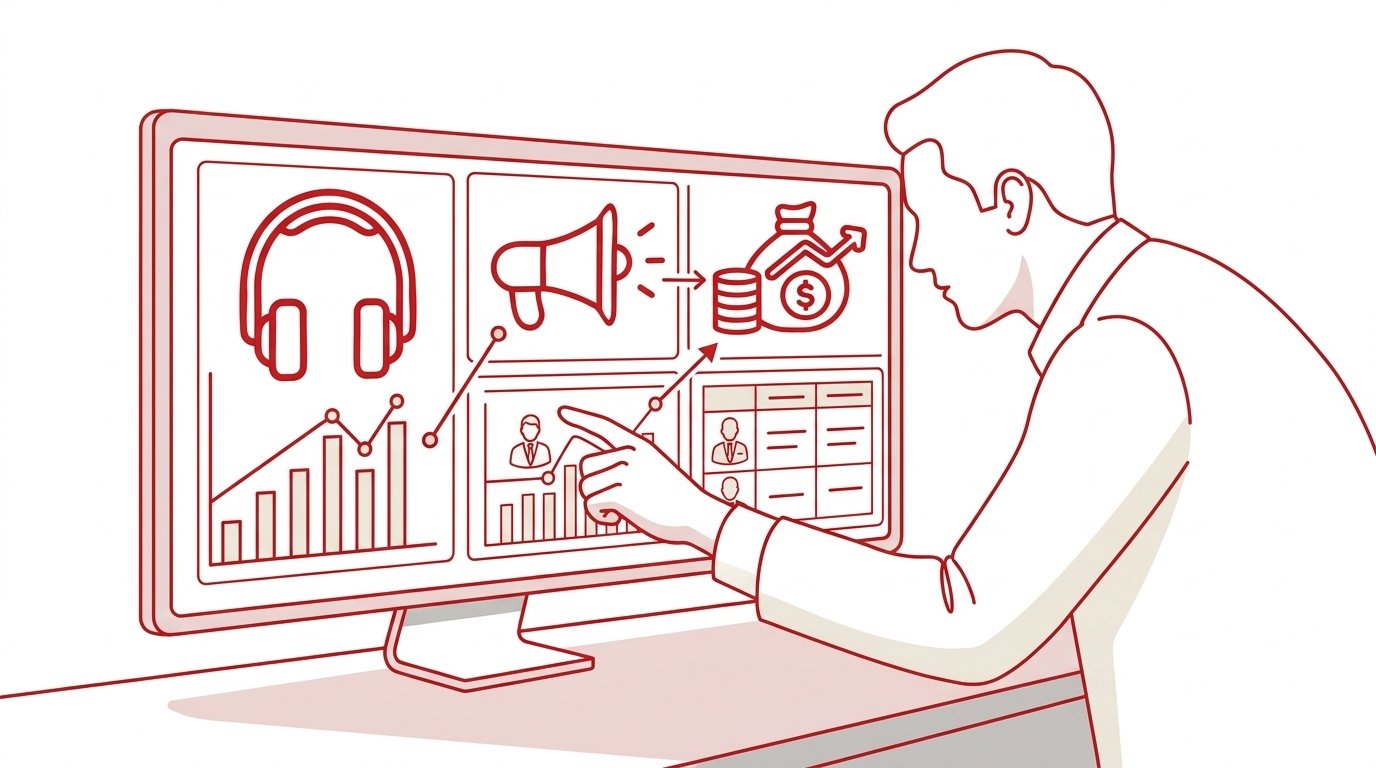
Closing that gap means measuring what a B2B show actually does. That breaks into four layers:
- Account engagement: whether the companies on your target account list are consuming, sharing, and responding to your content
- Pipeline attribution: how often the show shows up in the buyer's own account of how they found you
- Relationship velocity: how quickly connections with guest companies move from first recording to real opportunity
- Trust assets: the growing library of expert conversations that keeps working long after the recording ends
This article walks through each layer, from fixing broken attribution to building an executive-ready quarterly report. None of it requires software you don't already own. It requires deciding that your show is a GTM asset built on the give-not-take dynamic that makes buyers trust brands again, and then instrumenting it like one.
The problem with download metrics
Start with what a download actually measures. The IAB Tech Lab's podcast measurement guidelines are explicit that measurement is based on server logs, because shows are downloaded for consumption rather than streamed through the open connection other digital media maintain[2]. A download, then, is a validated file request. A machine asking a server for an MP3. No name attached, no company, no job title, and no proof anyone ever pressed play.
Counting downloads to prove B2B podcast ROI is like counting the trade show blankets you gave away. Satisfying number. Tells you nothing about who is actually wrapped up in one. Your CFO doesn't ask how many people might have heard of you. They ask whether the right accounts know you, trust you, and take your calls.
A download count cannot tell you:
- Whether a single listener works at an ICP-fit target account
- Whether the 13 internal stakeholders and nine external influencers in a typical buying decision heard the same conversation[3]
- Whether a recording changed how a prospect thinks about your category
- Whether anyone listened past the first two minutes
That's the core executive frustration. Leadership doesn't need to know how many; it needs to know who. Which is why the obsession with audience size is exactly backwards for a B2B show, where one expert conversation with the right guest can outweigh a thousand anonymous listeners.
Podcast pipeline attribution
Now for the mirage. Most attribution stacks were built to follow clicks. Multi-touch software lights up when a prospect opens an email, clicks an ad, or downloads a gated PDF. Audio doesn't behave that way. Someone listens to your show on their commute, away from every tracking pixel you own, and by the time they raise a hand the influence is invisible. Research makes the scale of this plain: 6sense's buyer research found 61% of the buying journey is already complete by the time a buyer first contacts a vendor[4]. Most of what convinced them happened where your CRM cannot see.
Take a typical case. A decision-maker hears your conversation with a guest from their industry. They never click anything. Three weeks later they hit a pain point, remember the discussion, and search your brand name directly. Your analytics dashboard logs it as direct traffic. Your CRM credits no campaign. The podcast did its job perfectly, and the system records a zero.
Podcast influence tends to surface in the places attribution tools ignore:
- Direct and branded organic traffic that lifts in the days after a new conversation goes live
- Open-text form responses that mention the show, the host, or a guest by name
- Discovery calls where prospects reference something they heard on your program
- Peer shares in Slack communities and private messages, where no link tracking survives
None of this means podcast impact can't be measured. It means the default stack was designed for a funnel your show doesn't live in. Treat the podcast as an asset that works across the full buyer journey, not a top-of-funnel awareness toy, and the measurement problem starts to look solvable.
Self-reported attribution workflows
The most effective fix for the dark funnel is almost embarrassingly simple: ask. A single open-text field, 'How did you hear about us?', on your demo and contact forms will surface podcast influence that no tracking pixel ever caught. Buyers volunteer it freely. They name the show, the host, or the guest they heard. Those answers are pipeline evidence straight from the buyer's own words, and they capture the word-of-mouth and dark-social paths that multi-touch models structurally miss.
Run it as a repeatable workflow:
- Add an open-text 'How did you hear about us?' field to demo requests, contact forms, and event registrations. Open text, not a dropdown. Dropdowns force buyers into your assumptions and bury the answer you need.
- Ask early, before memory fades, and train sales to ask the same question in discovery calls.
- Tag every mention of the show, a host, or a guest in your CRM with one consistent label.
- Review responses monthly and look for patterns: which guests, which topics, which target accounts keep appearing.
- Validate the answers against other signals, like direct traffic lifts and account engagement, before anything reaches an executive dashboard.
That last step matters more than it looks. Attribution researchers recommend asking early, keeping questions open-ended to capture nuance, tracking responses systematically so patterns can emerge, and validating self-reported data against other signals[5]. Skip one and the layer turns to noise. Do all of them and you get a defensible, directional read on where demand actually originates.
Then pair the qualitative layer with the quantitative one. Your CRM dashboard shows volume and velocity. Self-reported answers show origin and story. When a lift in direct traffic lines up with a wave of form responses naming your show, you finally have a complete picture of the pipeline your expert conversations generate, one neither system could draw alone.
Asking works for AI search, too. In Episode 2 of Cited Conversations, Simon Wilhelm, Co-Founder & CEO of SCAILE, named two ways to tell whether a brand's AI visibility is improving: follow the clicks that arrive from AI chatbots and AI Overviews in Google Analytics through to a booked meeting or a purchase, and use self-attribution. For B2B, his advice is to add the question to your book-a-meeting form and "just ask them, 'Where did you find us?'"
Podcast ABM metrics
If you run account-based marketing, the next number will feel familiar. In Momentum ITSMA's benchmark research, 81% of ABM practitioners rate its ROI higher than traditional marketing, yet only 52% of companies measure ABM ROI at all[3]. A 29-point gap between belief and instrumentation. Podcasting sits inside the same blind spot, which is a shame, because a show engages accounts the way ABM always promised: continuously, across the whole buying committee, without a single cold call.
Measuring podcast impact on target accounts means shifting the lens from leads to accounts. Stop asking how many people listened. Start asking what is happening inside the companies that matter:
| Account-level signal | What it tells you | Where it lives |
|---|---|---|
| Account-level consumption | Target accounts are spending real time with your content | Hosting analytics paired with IP-based account identification |
| Buying-committee reach | Multiple stakeholders at one account heard the same message | CRM contacts per engaged account |
| Engagement trend | Cold accounts are warming across consecutive conversations | Account engagement scores, quarter over quarter |
| First-party intent | An account is moving from listening to actively researching you | Direct traffic, branded search, repeat pricing page visits |
This is the always-on ABM effect at work. Regular expert conversations keep your brand present with target accounts between sales touches, reach multiple stakeholders with one asset, and let buyers engage on their own schedule. Watch the trend line, not any single recording. A cold account that consumes three conversations in a quarter is warming, and that is a signal sales can act on. Build the show into your ABM playbook as the warming layer that runs before and between every outreach sequence.
Guest relationship and referral tracking
Now for the most direct revenue driver in the framework: the guests themselves. Every expert conversation is a give. You hand someone your platform, your audience's attention, and 45 minutes of genuine interest in their work. In a B2B world where buyers screen calls and unsubscribe from email, that kind of generosity is rare enough to be memorable. Memorable is what compounds into referrals, partnerships, and opportunities over time.
Track relationship velocity with a simple scorecard:
- Guest-company opportunities: did a conversation with your team follow the recording?
- Referrals: did the guest introduce you to peers in their network?
- Warm amplification: did the guest share the conversation with their own audience?
- Origin stories: do closed-won deals mention a guest conversation in how they found you?
- Repeat engagement: do past guests return for roundtables or send colleagues your way?
The referral channel is bigger than most teams realize. ITSMA's ABM research found 77% of companies using ABM report it helped them generate more referrals[6]. A podcast supercharges that effect, because every guest leaves the recording having seen your expertise up close. None of this is guaranteed guest by guest, and you shouldn't forecast it as if it were. Tracked over a year, though, the pattern is unmistakable.
Operationally, this lives in your CRM and your follow-up rhythm. Tag guest companies, log the introductions, and set a consistent post-recording follow-up so the relationship doesn't end when the audio does. The teams that win here treat guest relationships as a pipeline discipline, not a nicety.
B2B podcast performance
Put it all together and you have a report a CFO will actually read. The backdrop makes the case for you: Gartner's survey of 646 B2B buyers found 67% prefer a rep-free experience, and 45% used AI during a recent purchase[7]. Buyers vet vendors on their own, through content they trust, long before they talk to anyone. A library of high-quality expert conversations is precisely the trust asset that journey rewards.
Structure the quarterly report around the four layers from the start of this article:
| Report section | What goes in it | Question it answers |
|---|---|---|
| Account engagement | Target accounts consuming, sharing, and responding, with quarter-over-quarter trends | Are the right companies paying attention? |
| Attribution evidence | Self-reported mentions, branded search lifts, direct traffic patterns | Is the show entering the buyer's story? |
| Relationship velocity | Guest-company opportunities, referrals, and warm introductions | Is the network compounding? |
| Trust assets | Library growth: transcripts, Q&A breakdowns, and derivative content | Is the show building lasting visibility? |
The compounding piece is what one conversation leaves behind. A single captured recording can generate more than 40 derivative assets: transcripts, Q&A breakdowns, social clips, and structured answers that AI agents can index and cite. Every conversation adds to a library that keeps building your visibility long after the mic is off.
Which is where the partnership model matters. Capturing conversations at this standard is heavy lifting: guest sourcing, tech checks, recording logistics, derivative workflows. Ringmaster runs that capture engine end to end as a collaborative partner, so your team stays focused on what only it can do: choosing the right guests and having real conversations. The structured libraries we capture feed your AEO partners and your GTM team alike, moving each expert conversation from recording to revenue. Measure what matters, and the podcast stops being a leap of faith. It becomes the most human, most defensible line in your go-to-market plan.
Frequently asked questions
Why are podcast downloads a bad metric for B2B?
Downloads only measure how many times a file was requested, not who is listening. B2B success relies on reaching specific decision-makers and target accounts, making total volume a misleading vanity metric. Marketers need account-level visibility to prove real business impact.
How do you measure podcast pipeline attribution?
The most effective method is self-reported attribution. By asking inbound leads "How did you hear about us?" on booking forms, you capture the dark funnel consumption that digital attribution software misses. This ensures your podcast gets the credit it deserves when it influences a deal.
What are the best podcast ABM metrics to track?
Track account-level consumption, multi-stakeholder reach within target accounts, and the velocity of deals when an account has engaged with your podcast content versus when they have not. Even though 81% of ABM practitioners rate its ROI highly, only 52% measure it effectively.
How does a B2B podcast drive immediate ROI?
The fastest return comes from the guest strategy. By inviting target accounts and industry experts onto the show, you build authentic relationships that can open doors to warm introductions and referrals over time, though none of it is guaranteed guest by guest. It turns a traditional sales "take" into a collaborative "give."
Why is my marketing dashboard missing podcast leads?
Audio consumption happens in the dark funnel. Listeners hear your show on a platform like Apple Podcasts, then weeks later search your brand name on Google. Software attribution falsely credits organic search instead of the podcast, creating an attribution mirage.