
You just captured a 45 minute conversation with a genuine expert. Real back-and-forth, a follow-up question that unlocked a story nobody has written down anywhere, a hot take your marketing team could never have scripted. Then the file gets uploaded, the conversation goes live, and the whole thing retires into your podcast feed. The expertise is real, but it is trapped in audio. If nobody presses play and listens to the end, it may as well not exist, and the newest audience you need to reach definitely is not pressing play.
That matters more now than it did two years ago. Spoken expert dialogue is the opposite of commodity content. It produces original perspectives, named attributions, and entity-rich detail that AI-generated rewrites simply cannot manufacture. And your buyers are now doing their research in the places where that raw material gets retrieved: G2's survey of more than 1,000 B2B software buyers found 87% say AI chatbots are changing the way they research software, and half now start their buying journey in an AI chatbot instead of Google[1]. When a buyer asks ChatGPT a question about your category, the answer gets built from structured, citable text. Audio alone gives the AI agents nothing to work with.
- The guest's sharpest framework, explained in their own words, exists only as sound
- The statistics and specific claims they made are unsearchable and unciteable
- The human attribution, the named expert on the record, never reaches the answer engines
- Your content team starts every week from a blank page instead of a transcript
The irony is that the show is already working. In self-reported attribution data, as many as 43% of qualified leads cited podcasts as a primary discovery channel[2]. The conversations are earning attention. The written derivatives of those conversations are what turn one recording into searchable, citable, reusable assets, and that makes them the highest-leverage part of the entire show. This is the gap a dedicated podcasting-for-AI-agents approach closes: same conversations, structured so they do not stay invisible.
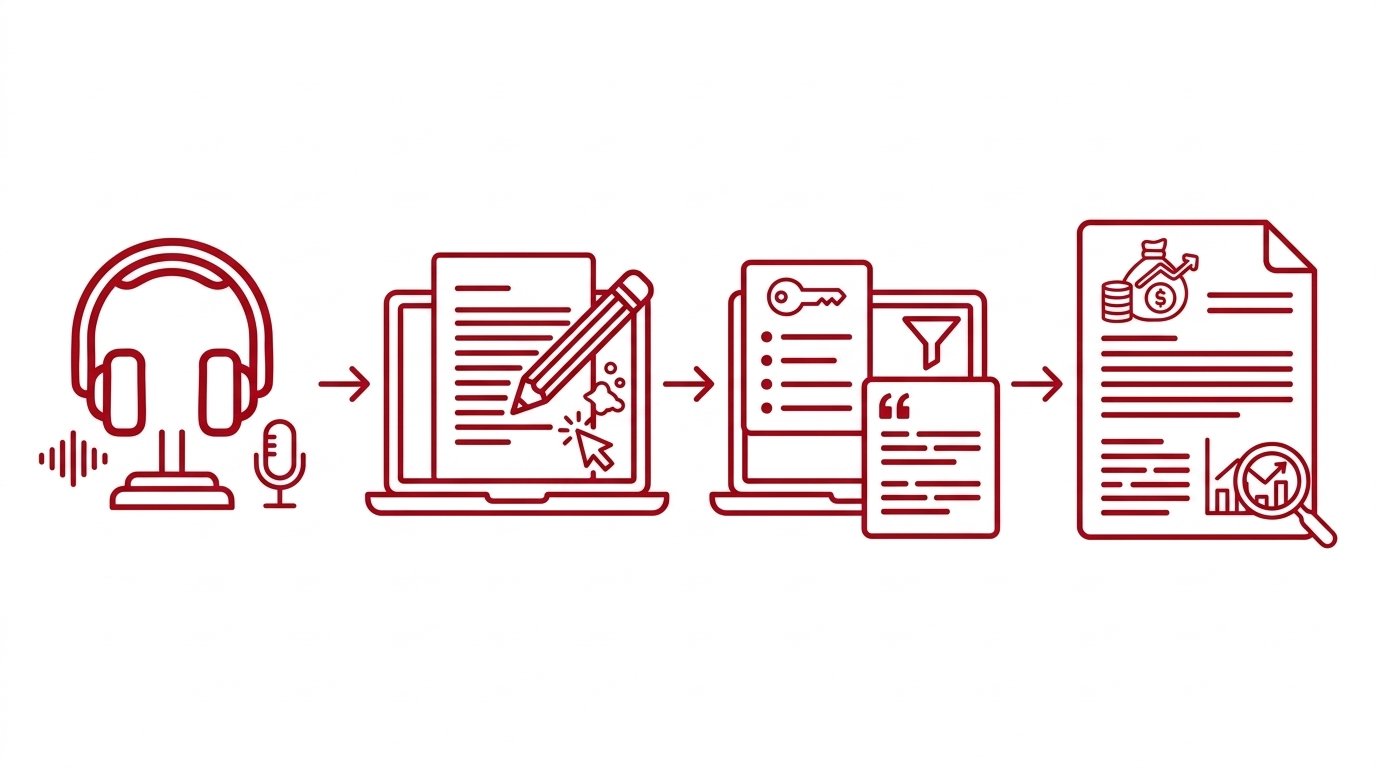
The episode-to-article workflow: four steps from audio to asset
Turning a recording into an authoritative article is not a writing task. It is a pipeline, and like any pipeline it succeeds or fails before the first step runs. Planning is the 80 in the 80/20 rule: decide the outcome document before you hit record. What question should this conversation answer, for which reader, with which named expert on the record? When you design the questions up front, the conversation arrives already structured for extraction. When you do not, you are mining a rambling hangout for something publishable.
- Audio → Clean Transcript: the recording becomes accurate, speaker-labeled text, the master source for everything downstream
- Clean Transcript → Entity Extraction: people, companies, tools, claims, and statistics get pulled out and organized
- Entity Extraction → Deep-Dive Article: the strongest material is reorganized into one authoritative written piece
- Deep-Dive Article → Derivative Library: the cornerstone feeds Q&A breakdowns, guides, and social assets (more on that below)
Between every step sits an editing checkpoint, and it is non-negotiable. Nothing publishes unverified: confirm names, product references, numbers, and claims at each handoff, because an error that survives step one gets amplified by every step after it. The workflow shape itself is well established. CastScribe's repeatable transcript-to-article process runs clean the transcript, identify the conversation's core promise, group related sections into a logical outline, then rewrite spoken explanations as direct paragraphs, with a human accuracy and intent check before anything goes live[3]. Set it up once, and the same system runs every week.
Repurpose the podcast transcript: clean it, don't rewrite it
Think of the transcript as the master source document, not the finished article. It follows the rhythm of conversation: tangents, housekeeping, sentences that trail off. The job at this stage is hygiene, not prose. You are protecting the two things that make expert content valuable, accuracy and authenticity, before anything downstream touches it.
- Strip: filler words, false starts, crosstalk, inside jokes
- Keep: the expert's actual words, phrasing, and verbatim quotes, because that voice is what AI-generated rewrites lose
- Fix: spelling of names, company and product references, technical terms, and speaker labels
- Flag: any claim, number, or URL that needs verification before it reaches an article
Why the human pass? Because automated transcription is very good, but not perfect. On clean audio, modern AI transcription reaches roughly 95 to 98% accuracy, which still means about one error per 20 words on a 1,000-word transcript[4]. Accuracy drops as conditions get harder: background noise is the biggest killer, and while AI tools handle two to four clean speakers well, accuracy degrades with more speakers, overlapping talk, and heavy accents[4]. That is why a human review of names, terms, and speaker labels is a hard requirement, not a nice-to-have.
And misattributed speakers are not a small typo. A quote pinned to the wrong expert poisons every downstream asset: the article, the Q&A breakdown, the social clips, the schema markup. Attribution is the asset. Capturing tacit expert knowledge at scale only works when the source document is trustworthy, which is exactly where most in-house efforts at SME knowledge capture fall apart.
Once the transcript is clean, extraction turns a conversation into structured material. This is where spoken expertise becomes machine-findable. You are not summarizing; you are inventorying what the conversation actually contains so both human readers and AI agents can pull it apart and reuse it.
- People: the named experts, their titles, and their organizations
- Companies and tools: every platform, vendor, and product referenced
- Definitions: concepts the experts explained in plain language
- Claims and statistics: the specific numbers and assertions worth citing
- Steps and frameworks: any numbered process or methodology that emerged
Structure beats polish here, and there is peer-reviewed evidence for it. The Princeton, Georgia Tech, Allen Institute for AI, and IIT Delhi study presented at KDD 2024 found that adding expert quotations lifts visibility in AI answers by 41%, statistics by 32%, and authoritative source citations by 30%, changes that require no redesign, only restructuring[5]. Read that list again: quotations, statistics, citations. That is a precise description of what a well-captured expert conversation is made of.
Then format the extracted material for retrieval, not just readability. Q&A blocks that mirror the questions buyers actually ask, definition pages for the concepts your experts named, and schema markup that labels the entities explicitly all make the same expertise retrievable by answer engines. A human reader gets a scannable guide. An AI agent gets clean, attributable claims it can cite back to a named person. Same source, two audiences, one capture.
Now you write, and the first decision is subtraction. A 45-minute conversation contains several possible articles: a how-to guide, a contrarian opinion piece, a comparison, a checklist. Pick one. The strongest angle sits where three circles overlap: the conversation topic, the problem your audience is trying to solve, and the intent behind what people search for. Trying to summarize the whole conversation produces an article about nothing in particular; forcing loosely related topics into one post dilutes all of them[3].
- Choose the single angle where conversation topic, audience problem, and search intent overlap
- Group related transcript sections into a logical outline instead of keeping conversation order
- Rewrite spoken explanations as direct, written paragraphs with clear transitions
- Preserve verbatim quotes, attributed to the named expert, where their voice carries the point
- Add framing for search visitors who lack the audio context, plus headings and a clear next step
That reorganization step is where most teams stall, because conversation order is not argument order. The best story usually shows up in the middle of the recording, sandwiched between a tangent and a sponsor read. Pull the related transcript sections together, sequence them so the argument builds, and let the article stand on its own for a reader who will never hear the episode.
One rule protects the whole thing: rewrite the explanations, keep the quotes. Spoken prose needs to become written prose, but the expert's verbatim lines stay verbatim, with their name and title attached. That human attribution is what both buyers and AI engines trust more than generic copy, and it is the one thing a content team writing from scratch can never reproduce.
B2B content repurposing: one conversation, a full content library
The deep-dive article is not the finish line. It is the cornerstone, the canonical written asset that every derivative cites back to, along with the source recording. Publish it once, then multiply it. That turns an expert conversation from a standalone asset into a content multiplication engine, and it is where the real efficiency lives: one captured conversation, an entire library of high-intent written assets, nothing created from scratch.
- Q&A breakdowns pairing the exact questions with the expert's exact answers
- How-to guides built from the steps and frameworks the conversation surfaced
- Comparison pieces drawn from the tools and trade-offs the experts debated
- Social posts and quote graphics carrying the verbatim lines
- Newsletter editions that link every derivative back to the cornerstone article
The brands doing this well run it as a system. Gong cuts episodes into clips embedded across blogs, social, and email, and that multi-format approach reportedly contributes to around 80% of its inbound pipeline[2]. Qualio turned 112 recorded conversations from its show into detailed blog posts with full transcripts, woven through the rest of its content marketing[2]. And the multiplication is generous: a single well-captured conversation can generate 40 or more derivative assets, from transcripts and Q&A breakdowns to social clips and show notes.
Run the workflow weekly and something bigger happens than volume. Every article reinforces the last one, the entity associations compound, and your domain starts building topical authority on the subjects your experts actually know. The content machine does the compounding for you, and it reaches buyers across the full journey, going beyond top-of-funnel.
Expert conversation capture: making the workflow repeatable
The payoff comes from running the workflow every week, and that starts before recording: design the questions in advance so the conversation is structured for extraction from the first minute. Know the outcome document, know the entities you want on the record, and the capture almost runs itself. Casey Cheshire, Founder & CEO of Ringmaster, estimated in Episode 1 of Cited Conversations that one 45-minute expert conversation per week produces more structured, AI-visible content than a full-time content writer can produce in a month, with real human attribution attached.
What burns teams out is everything around the conversation: guest sourcing, scheduling, tech checks, transcription, cleanup, extraction, drafting, derivatives. That is the heavy lifting, and it is exactly what a capture partner should take off your plate so your team focuses on strategy and the guest relationship. That is the Ringmaster approach: a content capture engine that has launched more than 75 B2B podcasts and turns each expert conversation into a structured, AI-ready content library through its Plan, Capture, Transform framework. Its Professional tier is built around monthly expert conversations with full episode capture, while the Prestige tier adds hosted roundtables and high-volume derivative capture for teams that want maximum output. The point is never outsourcing the thinking; it is protecting your experts' time for the part only they can do.
- Design questions before recording so every conversation is extraction-ready
- Let the partner handle sourcing, recording, transcripts, and derivative capture
- Measure output in published assets and relationships built, not downloads
- Keep the verbatim attribution intact from transcript to article to derivative
Measure the machine, not the microphone. Downloads tell you how many people listened once. Published assets tell you how much searchable, citable expertise you banked this quarter, and relationships tell you whether the right people now know your experts by name. That is the scoreboard that compounds, and it is why podcasting belongs in your 2026 go-to-market plan as a relationship and revenue play, not a creative side project. Capture the conversation once, structure it well, and your best content stops being trapped in audio and starts working everywhere your buyers, and their AI agents, are looking.
Frequently asked questions
Can you turn a podcast conversation into a blog article?
Yes, but not by pasting the transcript into a post. The working method is to extract the argument, pick one reader-focused angle, reorganize the strongest ideas into an outline, then rewrite spoken explanations as direct paragraphs while keeping real quotes from the named expert. A single conversation often contains several possible articles: a how-to guide, a checklist, or a comparison piece.
Should I publish the raw transcript or edit it first?
Edit it, but lightly. Strip filler, false starts and crosstalk, and fix speaker labels and technical terms, but keep the expert's actual words. Verbatim quotes carry authenticity that AI-generated rewrites lose, and research shows adding expert quotations to content lifts visibility in AI answers by 41%. The goal is a clean, attributable source document, not a polished essay.
How accurate is AI transcription for podcast audio?
Very good, but not perfect: on clean audio you are still looking at roughly one error per 20 words, and accuracy drops further with background noise, more speakers, overlapping talk, and heavy accents. That is why a human review pass on names, company names and speaker labels is non-negotiable before the transcript feeds any published asset.
What is entity extraction in content repurposing?
Entity extraction means pulling the named things out of a cleaned transcript: people, companies, tools, definitions, statistics and step-by-step processes. Those extracted pieces become Q&A blocks, definition pages and structured markup that both human readers and AI agents can retrieve, so the expertise stops being trapped in audio.
How many content pieces can one expert conversation produce?
A single 45-minute expert conversation can generate a full library: a cornerstone deep-dive article, Q&A breakdowns, how-to guides, social posts and newsletter editions. Brands like Gong and Qualio treat each recording as a content multiplication engine, with each conversation feeding weeks of multichannel assets rather than one standalone post.
Does repurposing podcast content help with AI search visibility?
Yes, because AI answer engines retrieve structured text, not audio. The KDD 2024 study found that adding expert quotations, statistics and authoritative source citations to content measurably lifts visibility in AI-generated answers, all through restructuring rather than redesigning content. A cleaned transcript with real named experts is exactly the raw material those signals need.
How long does it take to convert a recording into an article?
With a repeatable workflow it is a matter of hours, not days: clean the transcript, extract entities and key quotes, outline around one angle, then draft and fact-check. The biggest time saver is planning before recording, because a conversation designed around stated outcomes extracts cleanly, while an unstructured one needs heavy reorganization before it becomes an article.