
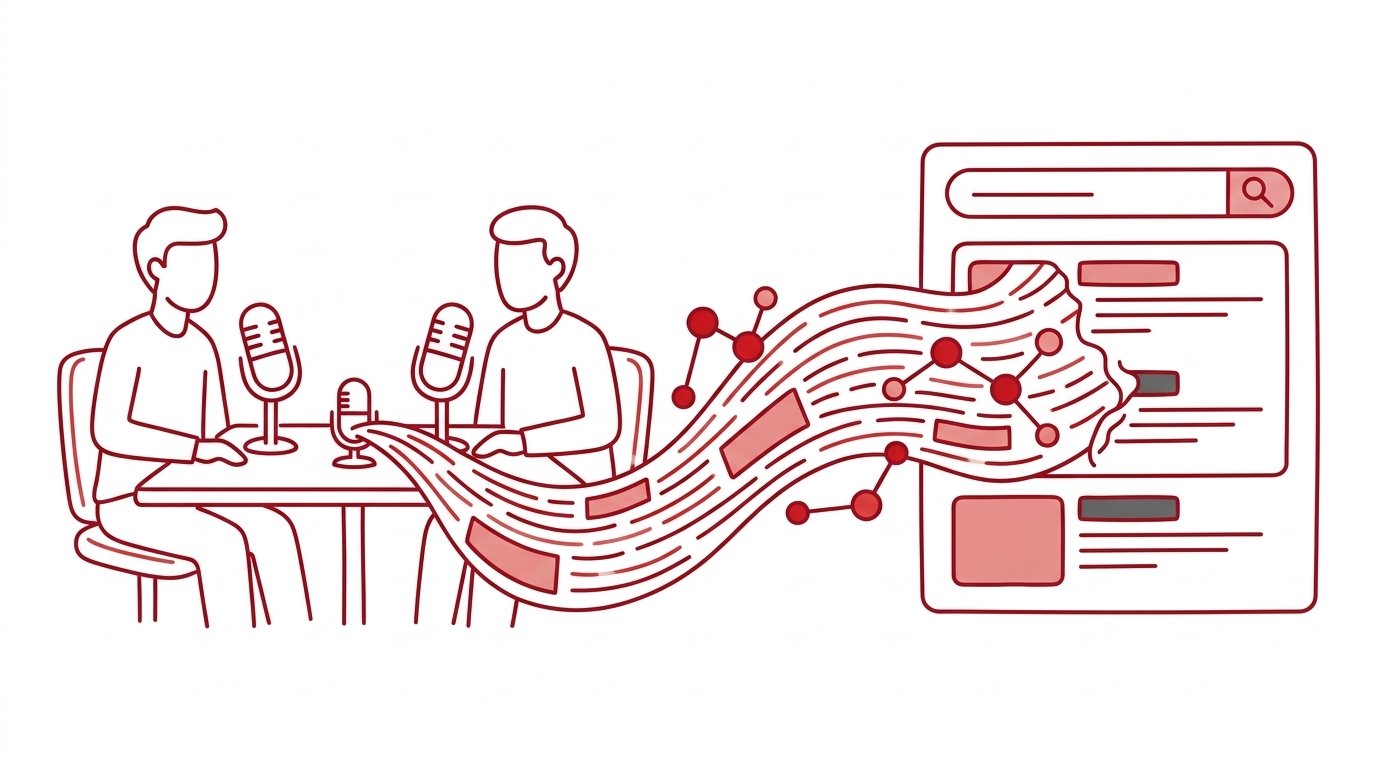
B2B Podcasting in the AI Era
Here's the shift that should be reshaping your 2026 go-to-market plan: your buyers are no longer starting with Google. They're opening ChatGPT, Perplexity, or Gemini and asking it to shortlist vendors. In G2's survey of more than 1,000 B2B software buyers, 87% said AI chatbots are changing the way they research, and half now start the buying journey in an AI chatbot instead of a traditional search engine[1]. Gartner expects traditional search engine volume to drop 25% by 2026 as AI chatbots and other virtual agents replace queries that used to run through search[2].
This is a major discovery shift. When a buyer prompts "give me three options for X," the AI agent builds the shortlist from the sources it can read, trust, and cite. If your company's expertise isn't in that mix, you're not losing a ranking position. You're not on the canvas at all.
And here's the uncomfortable part for most content teams: the blog posts, whitepapers, and thought-leadership articles you've been shipping are increasingly AI-generated or AI-assisted, which means AI engines treat them as commodity content. There's no differentiation, no real human voice, no verifiable expertise. What generative engines are starving for is original, human-sourced expert knowledge, the kind that only exists when two real experts talk. That's exactly what a B2B podcast captures. But only if you build it for this era, not just for human ears.
- 87% of B2B software buyers say AI chatbots are changing how they research[1]
- Half of buyers now start the buying journey in an AI chatbot instead of a search engine[1]
- Gartner expects traditional search engine volume to drop 25% by 2026[2]
- A podcast built only for human listeners misses the fastest-growing discovery channel entirely
The takeaway is simple: if your podcast strategy is still "record it, publish it, hope people listen," you're optimizing for a channel that's shrinking. The opportunity is to treat every expert conversation as raw material for AI visibility. That's what the rest of this guide covers.
AI Engine Optimization and Your Podcast
Let's define the term without the jargon. AI Engine Optimization (AEO) is the practice of making your company's expertise visible, citable, and recommendable inside AI-generated answers. Not ranked on a results page. Quoted, referenced, and recommended in the answer itself. When a buyer asks an AI agent "who's good at X?", AEO is what determines whether your company's name, your executives, and your methodology show up in that response.
This isn't a fringe behavior. Forrester's State of Business Buying, 2026 report found that generative AI is fundamentally reshaping how business buyers discover, evaluate, and purchase products and services, with genAI searches now the starting point for B2B buyers[3]. Forrester's earlier B2B Buyer Adoption of Generative AI report found that in less than two years, 89% of B2B buyers adopted generative AI, naming it one of the top sources of self-guided information in every phase of their buying process[4].
So why is a podcast a natural fuel source for AEO? Because of what it captures that other content can't: real expert dialogue. When two genuine experts talk through a problem, they produce original perspectives, first-hand experience, and verifiable claims. That's the opposite of commodity AI-generated content, and it's exactly the kind of material AI engines need to build trustworthy answers. A podcast gives your AEO strategy something worth optimizing: human-sourced, entity-rich content that no competitor can generate with a prompt.
- AEO means being cited and recommended inside AI-generated answers, not ranked on a results page
- Buyers now lean on generative AI at every phase of the buying process, per Forrester's adoption research
- Podcasts capture original, verifiable expert dialogue instead of commodity AI-generated content
- That human-sourced material is what gives an AEO strategy real substance to work with
One important boundary to keep straight: the podcast itself isn't the AEO strategy. It's where the raw, human-sourced expertise gets recorded. The AEO work (structuring, optimizing, and distributing that expertise so AI engines cite it) happens downstream. Keep those two roles separate in your planning, and the whole system works better.
Content Capture for AI Agents
This isn't a theoretical problem, either. It's the exact reason new infrastructure is being built right now to turn spoken conversations into something machines can read.
TechCrunch reported on Radar, a podcast search engine that transcribes more than 130,000 podcasts with speaker labels and rich metadata, understanding the entities being discussed: people, companies, brands, products, and topics[5]. Why does it exist? Because, as Particle CEO Sara Beykpour put it, "Agents are generally blind to audio; they can't see it unless something or someone has transcribed it"[5]. The entire product category is proof: audio only becomes AI-visible through transcription and structure.
That changes how you should think about your podcast. It's not the end product. It's the capture mechanism. The recording is just the input. What actually feeds AI agents, and your AEO strategy, is everything you derive from it: the transcript, the structured show notes, the Q&A breakdowns, the entity-rich articles. The capture and transformation process matters as much as the recording itself, because that's where audio becomes something an AI engine can actually consume.
- Record the expert conversation (the capture step)
- Transcribe it with speaker labels and clean structure
- Break it into Q&A pairs, key quotes, and topic sections
- Publish entity-rich derivatives: articles, show notes, structured pages
- AI agents and indexes consume the text, associate your entities, and cite you
Think of it this way: the conversation is the mine, the derivatives are the ore, and your AEO partner refines it. If you skip the capture-and-transform step and just publish audio, you've done the hard part, the genuine expert dialogue, and thrown away the part AI engines actually read.
AI Search Visibility: What Engines Reward
So what actually earns visibility in AI-generated answers? The research is still young, but the signals are getting clearer. The Princeton-led GEO study, the first large-scale academic look at this, showed that optimization tactics such as adding citations, quotations from relevant sources, and statistics can boost a source's visibility in generative engine responses by up to 40%[6]. In plain terms: engines reward content that is specific, sourced, and quotable.
Gartner points to the same shift from the other side. As generative AI drives down the cost of producing content, search algorithms will further value the quality of content to offset the sheer amount of AI-generated material, with greater emphasis on demonstrating expertise, experience, authoritativeness, and trustworthiness[2]. The flood of generic AI content is making genuine human expertise more valuable, not less.
The third signal, and the one podcasts are uniquely built to deliver, is entity associations. Every guest, every company, every methodology, every named framework you mention in an expert conversation becomes a connection AI engines use to build authority maps. When your experts talk with ICP-fit guests about the topics you want to own, they're not just creating content. They're building a web of real, verifiable relationships between your brand and the ideas you want to be known for. That's what AI agents trust when they decide who to cite.
| Signal | What it looks like | How podcasts deliver it |
|---|---|---|
| Citations and quotations | Specific, quotable statements from credible sources | Guests state positions and first-hand experience in their own words, ready to be quoted |
| Statistics | Concrete numbers instead of vague claims | Experts share real metrics and results from their work |
| Entity associations | Named people, companies, methods, topics | Every conversation links your brand to guests, topics, and terminology in the field |
| Demonstrated expertise | Verifiable human knowledge, not generic prose | Real dialogue between practitioners, impossible to generate with a prompt |
Notice what's not on that list: keyword density, publish volume, or content velocity. The engines are grading for authenticity and specificity. A single genuine expert conversation can carry more signal than a month of AI-drafted blog posts, because it contains things that can't be faked: real names, real experience, real numbers.
Designing Conversation Flows AI Agents Parse Easily
If engines reward specificity and quotability, then the way you structure the conversation matters as much as who's in it. A rambling, free-form chat might be pleasant to listen to, but it's hard for an engine to lift a clean, self-contained answer from it. Design the flow deliberately, and every conversation becomes easier to parse, quote, and cite.
Start before anyone hits record. Prep each conversation around the specific questions your buyers actually type into ChatGPT or Perplexity. If your buyers are asking "how do we solve X," your conversation should answer that question directly, in plain language, with a named expert attached to the answer. The prep going into a conversation matters as much as the optimization coming out of it.
- Prep around real buyer questions: the exact prompts your ICP types into AI tools, not just topics you find interesting
- Use a question-led flow: each segment opens with a clear question, so the answer that follows is self-contained and liftable
- Have speakers name entities explicitly: people, companies, methods, frameworks, said out loud, not implied
- Push for concrete numbers and first-hand experience: real figures and specific stories make answers quotable and verifiable
- Close each segment with a clean takeaway sentence that summarizes the answer in one quotable line
A quick example of the difference. A generic answer sounds like: "Yeah, I think a lot of teams struggle with that, and there are a few approaches." A parseable answer names the company and the numbers: "The three-step onboarding method we use is scope, script, capture, and it cut our ramp time in half." The second gives an engine everything it needs: a named entity, a structured method, a concrete result. That's the kind of answer that gets lifted, cited, and attributed.
This is also where strategic guest sourcing pays off. When your guests are ICP-fit, the entities they name, the companies they reference, and the problems they describe are all relevant to the authority map you're trying to build. Random industry voices produce random entity associations. Chosen guests reinforce the exact topics you want to own.
From One Conversation to an Entity-Rich Content Library
Here's where the math gets fun. Every derivative you produce from a single 45-minute conversation is another surface AI agents can read, parse, and cite.
From a single recording, the derivatives stack up like this:
- A full transcript with speaker labels and topic headers, the base layer everything else is built from
- Q&A breakdowns that pair each question with its self-contained answer
- Structured show notes listing named entities, key quotes, and timestamps
- Entity-rich articles and blog posts built from the conversation's substance
- Short clips and audiograms, each published alongside its own text description
Why does structure matter so much? Because clean transcripts with speaker labels and topic headers are exactly the format AI agents and indexes like Radar consume[5]. When you publish your own derivatives in that same structure, you're speaking the native language of the machines that decide who gets cited.
Every derivative reinforces the same entities and the same expertise from a slightly different angle. Stack that across a weekly cadence, and you're not publishing content anymore. You're building a compounding library of human-sourced, entity-rich material that gets harder and harder for competitors to replicate.
The Practical Workflow: Capture First, Then Optimize
Let's put it all together into an operating model you can actually run. The cadence is simple: one expert conversation per week, with strategically sourced guests drawn from your ICP. Every guest is chosen because the conversation builds authority on the topics you want to own, not because they have a big audience. The consistency matters more than the volume. One conversation a week, every week, compounds into a serious library within a quarter.
The division of labor is just as important. This is a two-part system, and it works best when each side does what it's built for:
- The content capture engine: designs the conversation flows, sources ICP-fit guests, and handles production logistics.
- It also transforms each recording into an entity-rich library of transcripts, Q&A breakdowns, and structured derivatives.
- This is the front end of the AI visibility pipeline: someone captures the expert conversations so AI engines can consume them, while you focus on strategy and the conversation itself.
- The AEO partner: takes that library and optimizes it for AI engines, structuring and distributing the material and measuring how your entities perform in generative answers.
- The capture engine feeds the AEO strategy, and the AEO partner optimizes it.
Frequently asked questions
Can AI search engines listen to podcast audio?
No. Generative engines only reach your audio once it has been transcribed, so a podcast contributes to AI search visibility through its text derivatives: transcripts, expert conversation write-ups, Q&A breakdowns, and structured show notes.
What is AI Engine Optimization (AEO)?
AEO is the practice of making your company visible inside AI-generated answers, so engines like ChatGPT and Perplexity cite and recommend you when buyers ask category questions. It differs from SEO because the goal is citation and recommendation within a synthesized answer, not a ranking on a list of links. Forrester found that 89% of B2B buyers have adopted generative AI as a top source of self-guided information in every phase of buying, which is why AEO has moved from experiment to priority.
How do I get my company mentioned by ChatGPT or Perplexity?
You need citable, entity-rich source content that answers the exact questions buyers ask. Research on generative engine optimization shows that content containing citations, quotations, and statistics can see visibility gains of up to 40% in generative answers. Structured expert conversations with named people, companies, and concrete numbers are a reliable way to create that source material.
What kind of content do AI search engines prioritize?
Engines increasingly reward quality, authenticity, and demonstrated expertise as AI-generated content floods the web. Gartner notes that search systems will further value content quality and authenticity signals like expertise, experience, authoritativeness, and trustworthiness. Original, human-sourced expert dialogue with real entity associations stands out against commodity AI-generated content.
Is a B2B podcast worth it for AI visibility?
Yes, if it is designed for AI consumption and not just human listeners. Most podcasts are built for audiences only, so their content never reaches AI search. A podcast designed as a capture mechanism creates entity-rich transcripts and derivatives that AI agents can parse, cite, and recommend, turning one weekly conversation into a compounding visibility asset.
How much content can one podcast conversation create?
A single 45-minute expert conversation can generate dozens of derivative assets: a transcript, Q&A breakdowns, entity-rich articles, social clips, audiograms, and structured show notes. Each derivative is a separate, machine-readable surface where AI agents can encounter your experts and entities.
Does Ringmaster do the AI search optimization itself?
No. Ringmaster is the front-end content capture engine: it designs and captures the expert conversations and builds the entity-rich content library. Optimization for AI engines is handled by AEO partners who work with that structured material. Capture and optimization are separate disciplines.