
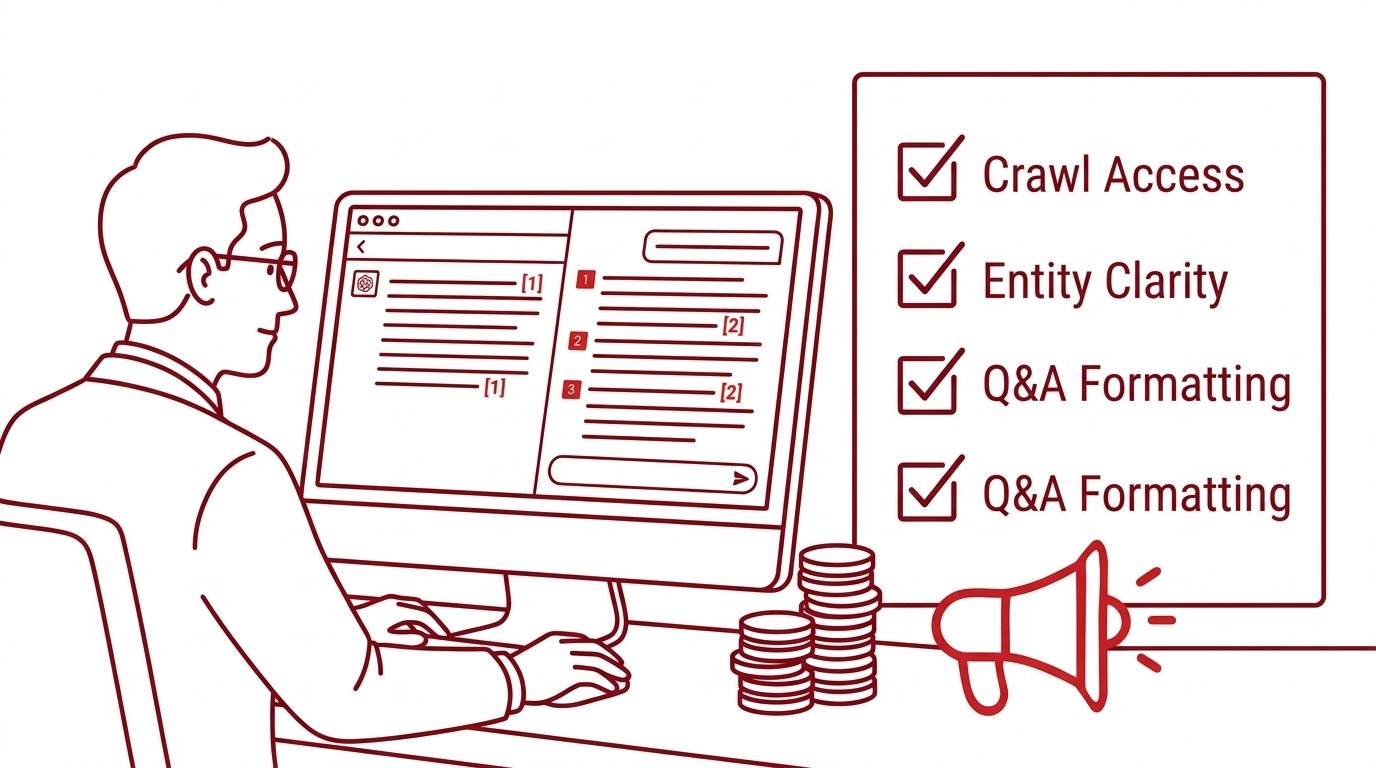
How ChatGPT search citations actually work
If you're building pipeline in B2B right now, the buyer's first stop isn't your website or a trade show. It's a chat window. Semrush surveyed 622 US B2B professionals and found that 92% say AI has shaped their vendor shortlist, with 45% saying it did so significantly[1]. That means the question "who should we even evaluate?" is increasingly answered by an AI agent, and if your brand isn't in that answer, you never make the list. Getting cited in ChatGPT search is no longer a nice-to-have experiment. It's demand gen infrastructure.
So how does a citation actually happen? OpenAI's own documentation explains that when ChatGPT search answers a question, it can rewrite your prompt into multiple targeted search queries and pull in external sources, then cite them in the response[2]. Profound breaks the full mechanism into three stages, and every lever you can pull maps to one of them[3].
- Retrieval: the engine turns your buyer's question into several search queries and pulls candidate pages from an index. If your page isn't retrievable for those queries, nothing else matters.
- Selection: the engine ranks the candidates and passes only the strongest to the model as context. Relevance, authority signals, and recency do the cutting here.
- Synthesis: the model writes the answer from those passages and names its sources, favoring pages it could parse cleanly and claims other sources back up.
Two numbers make the priority order clear. Ahrefs analyzed 1.4 million ChatGPT prompts and found that 88.46% of cited URLs come from the general search index, far ahead of news, Reddit, YouTube, or academic channels[4]. And even among retrieved pages, only about half end up cited at all. Being retrievable comes before everything else, then being selected, then being safe to quote.
ChatGPT search citations start with technical eligibility
Before content quality enters the picture, your site has to pass the crawl and rendering layer. This is the least glamorous part of the playbook and the one most teams skip. On Cited Conversations, Episode 2, Simon Wilhelm, Co-Founder and CEO of SCAILE, put it bluntly: ChatGPT does not read JavaScript, so on a JavaScript-heavy site it can only see the meta title and description, and it is effectively blind to everything else. His team runs a 29-step health check to find why a brand isn't being cited, and technical accessibility is always step one[5].
The fix is to keep your answer text in server-side rendered HTML rather than something the browser assembles after load. Wilhelm's example from the same conversation: travel and hotel booking widgets rendered in JavaScript are invisible to crawlers, and moving them into clean HTML raises the odds the engine serves them as the answer.
- Allow OpenAI's search crawler in your robots configuration so your pages can enter the candidate pool at all.
- Keep answer text in server-side HTML, not behind JavaScript rendering, so agents can read what you wrote.
- Confirm your key pages are indexed and crawlable, and fix anything blocking them.
One tool note: use Google Search Console for indexing and crawl diagnostics only. PodcastEpisode-style markup has no Google rich result, so rich-result testing tools tell you nothing useful here. The Schema Markup Validator at validator.schema.org is the right check for structured markup.
The complete, copy-paste example of the speaker entity markup described above looks like this. Paste it into the page's head, swap in your expert's real details, and check it with the Schema Markup Validator at validator.schema.org.
<script type="application/ld+json">
{
  "@context": "https://schema.org",
  "@graph": [
    {
      "@type": "Person",
      "@id": "https://www.example.com/#jane-doe",
      "name": "Jane Doe",
      "jobTitle": "Head of Revenue Operations",
      "worksFor": { "@id": "https://www.example.com/#organization" },
      "sameAs": [
        "https://www.linkedin.com/in/janedoe-example/"
      ]
    },
    {
      "@type": "Organization",
      "@id": "https://www.example.com/#organization",
      "name": "Example Company",
      "url": "https://www.example.com/"
    },
    {
      "@type": "WebPage",
      "@id": "https://www.example.com/answers/how-do-we-shortlist-vendors",
      "url": "https://www.example.com/answers/how-do-we-shortlist-vendors",
      "name": "How do B2B teams shortlist vendors in 2026?",
      "author": { "@id": "https://www.example.com/#jane-doe" },
      "publisher": { "@id": "https://www.example.com/#organization" }
    }
  ]
}
</script>
ChatGPT B2B visibility is built on entity clarity
Once the engine can read your pages, it has to answer a harder question: who is actually saying this? AI agents resolve entities, the named people and companies behind a claim, before they cite them. A page of unattributed prose gives the model nothing to verify. A named expert with a linked LinkedIn profile and a structured author page gives it a person it can check.
Wilhelm explains why this matters more now: there is more AI-written content on the web than human-written content, and model companies have already crawled and trained on the whole web. What they're hungry for is implicit expert knowledge that hasn't been written down yet. As Wilhelm puts it, if you're an expert writing down your knowledge and the AI can verify it's actually you, because you link your LinkedIn profile and keep a well-structured author page, AI will be far more likely to cite you. To give agents that verification path, apply four habits:
- Name the expert on every page where their expertise appears, with full name, title, and company.
- Link each expert's LinkedIn profile and maintain a structured author page the engine can resolve.
- Keep name, title, and company data consistent across your site, guest bios, and third-party profiles, so every mention reinforces the same entity.
- Use structured markup that names the speaker, so attribution doesn't depend on parsing prose.
Cited Conversations is a live example of this done end to end: it embeds speaker entity data, name, title, organization, and LinkedIn profile in each page's structured markup so AI answer engines can resolve attribution without parsing prose[5]. That's how AI agents decide which sources to trust, and it's why entity clarity is a visibility strategy, not a vanity project.
Get your brand mentioned: format answers as conversational Q&A
Entity clarity tells the engine who's talking. Page format decides whether it can lift what they said. Semrush's study of content qualities associated with AI citations across ChatGPT, Google AI Mode, and Perplexity found that Q&A format showed a +25.45% association with AI citations, clarity and summarization +32.83%, and structured data elements +21.60%, while a promotional tone showed a negative association[6]. The engines are asking questions behind the scenes, and pages shaped like answers win. Shape each page so the engine can lift it:
- One buyer question per page. Scope the page to a single question your ICP actually types, not a broad topic.
- Put the question's words in the title and H1, so the page matches the sub-queries the engine generates.
- Answer first. Give a self-contained answer in the opening paragraph, then expand underneath it.
- Write question-shaped headings for each section, so any passage can be lifted out and still make sense on its own.
Then take the sales language out. The same study found promotional tone works against citation, which tracks with everything else we know about how agents select sources: they want extractable evidence, not ad copy. Keep the pitch on your product pages and let your answer pages read like the honest, specific expertise they are.
Human-verified source material earns the trust layer
Formatting gets you into the conversation. Specifics get you cited first. A SIGIR 2026 study on competitive generative engine optimization built a controlled testbed that pitted two retrieved sources against each other and ran 252,000 paired trials across six LLMs[7]. Its finding: including explicit price information and a recent timestamp helps a source get cited first consistently, completeness and trust cues add smaller gains, and formatting-only edits have little impact. In a web drowning in generated text, verifiable human specifics are the differentiator.
Wilhelm's advice on Cited Conversations points the same direction: keep expert answers as raw as possible, because that's what makes them unique, and use real transcript quotes inside a content cluster rather than rewriting them into polished prose. A verbatim human quote is the one thing an AI agent cannot generate.
- State concrete specifics: pricing signals, dates, named frameworks, real numbers your experts actually said.
- Quote experts verbatim from transcripts instead of paraphrasing them into mush.
- Corroborate across sources, because a model hesitates to repeat a claim only one page makes and reaches for the one the rest of the web backs up.
If you want to see what the output looks like in the wild, browse Cited Conversations, our reference library where every claim links to its source and every speaker is named, or explore how B2B podcasting feeds AI agents in practice. The engines are already answering your buyers' questions. The only decision is whether your experts are among the names it has to cite.
Frequently asked questions
How do I get my brand cited in ChatGPT?
Work the pipeline in order. First make your pages technically reachable: allow OpenAI's search crawler and keep answer text in server-side HTML. Then publish pages that each answer one real buyer question, with the answer in the first paragraph. Finally, back claims with verifiable, named human expertise and specifics like pricing and dates, because corroborated claims are the ones a model can safely assert.
Does ChatGPT search use Google rankings?
Not directly. ChatGPT rewrites your question into one or more targeted queries and sends them to search providers, and the overwhelming majority of the URLs it cites, in one large study, come from that general search index rather than verticals like video or academic repositories. Being retrievable and relevant in search indexes matters more than any single ranking position.
Do I need schema.org markup to get cited in ChatGPT?
Markup is not a requirement, but it helps machines parse who and what a page is about. Validate markup with the Schema Markup Validator, and use Search Console only for indexing and crawl issues.
What content format gets cited most in ChatGPT answers?
Pages that answer one question directly. Put a self-contained answer in the first paragraph, use the buyer's question as the heading, and save context and opinion for below it.
Can an agency guarantee my brand will be cited in ChatGPT?
No. A citation depends on three stages you only partly control: retrieval, selection, and synthesis. No one can promise placement, and any partner claiming guaranteed citations should be treated with caution. What a good partner does is fix eligibility, build entity clarity, and publish citable, verifiable content, then measure what changes.
How do I measure whether ChatGPT is citing my brand?
Define a fixed set of prompts your buyers actually type, run them on a regular cadence, and record which citations appear and whether they link to pages you own or third-party pages that mention you. In one analysis of 11.84 billion AI citations, 57% pointed to brand-owned websites, so track both owned citations and earned mentions rather than downloads or traffic alone[3]. For the full metric set, see our guide to measuring AI search visibility.
Is podcast content citable in ChatGPT?
The audio itself is not what gets cited; the text is. Publish structured transcripts and Q&A breakdowns as readable pages with named speakers, titles, and companies, and the expertise inside the conversation becomes retrievable and quotable. That is the core idea behind building expert conversations for AI agents: capture the human expertise, then structure it so engines can find and cite it.