
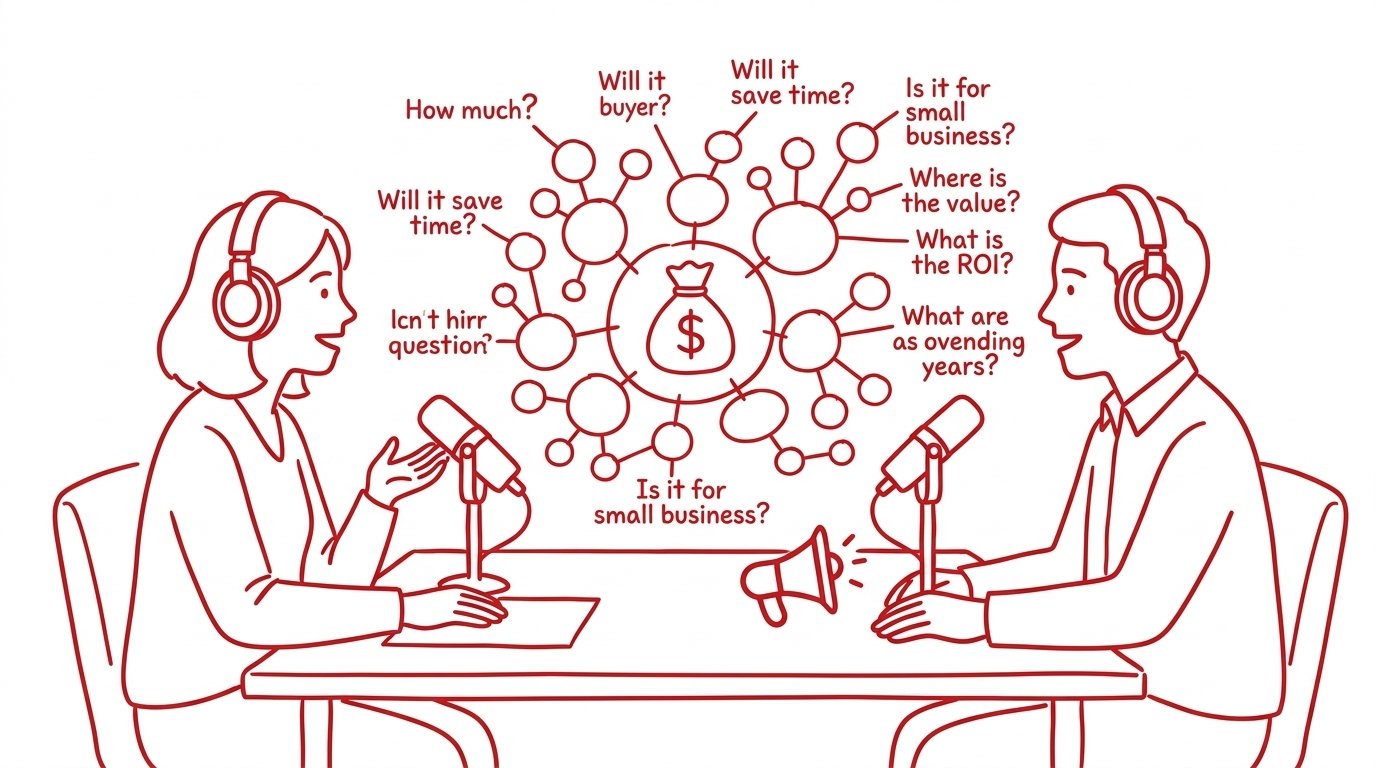
Why Question Design Decides Your AI Visibility
Your buyers stopped typing keywords. They ask ChatGPT, Perplexity or Gemini who to trust, and the engine answers with names: companies, people, frameworks. Responsive research found that 56% of tech buyers now use generative AI to build vendor shortlists[1]. If your expertise is not one of the sources an engine pulls from, that conversation happens without you.
So what decides whether a page gets cited? A study of 468,037 citations across 158,099 AI answers to commercial questions compared pages within the same website and found one content factor with a robust effect: pages whose titles and paragraphs match the questions people ask get cited more[2]. Retrieval, not page polish, explains 32% of the variation in citations, against 2.8% for on-page properties[2].
Read those two findings together and the leverage point moves upstream of publication. Answer engines retrieve pages that match buyer questions in meaning, which means the answers your expert gives on the record are the raw material, and the questions you ask in the room are the one control you hold before anything is published. Optimization after the fact cannot fix a conversation that never addressed the buyer's question in plain words.
Three implications follow for anyone running expert conversations:
- Retrieval works by meaning, so a conversation that never states the buyer's question in plain language gives an engine little to match against.
- Page properties explain very little of who gets cited; the match between question and answer does the work.
- The only moment you fully control is before recording: the questions themselves.
That is the premise of this guide. Treat question design as the planning stage of AI visibility, and give it the same rigor you give the edit. The sections below cover the ground rules, a copyable template bank, the framework that turns questions into a strategy, and the extraction prompts that pull out answers worth citing.
Expert Interview Question Design: The Ground Rules
Most expert conversations are planned as a list of interesting topics, and that is exactly why so much recorded expertise stays invisible. An engine cannot cite a rambling anecdote or a yes/no shrug. The craft rules for questions an expert can answer well, and an engine can use, are simple and testable.
- One idea per question. Asking about pricing and usability in a single breath forces the expert to pick one and drops the other. Split it: two questions, two clean answers.
- True open-ended prompts. Start with what, how, or tell me about. Closed did/do/is questions produce a yes, a no, and a pause.
- Neutral, non-leading wording. Why do you love X puts the host's assumption on the record. How would you describe X puts the expert's view there instead.
- A short framing lead-in. One sentence of context grounds the expert; a question stacked with nested clauses loses them.
- Name the thing explicitly. Do not make the expert guess what this or that refers to; name the topic in the question.
Pace matters too. Discussio's question-writing guide for AI-led interviews suggests aiming for an average of 15 questions or 30 minutes per conversation, because longer sessions lose the expert's attention and the answer quality drops with it[3].
For AI visibility, add one more rule: the question should use the words buyers actually say. The answer inherits the question's vocabulary, so a question built from buyer language produces an answer that matches what buyers type into an engine. The opening question sets that pattern for everything after it, which is why it deserves the most thought. Plan the right first question before anything else in the conversation.
SME Interview Questions: A Template Bank You Can Copy
Casey Cheshire, founder of the Plan, Capture, Transform Framework, made the case on the record in Episode 1 of Cited Conversations[4], the conversation What Makes a Podcast Agency an AI Visibility Agency? hosted by Adam Needles: "One well-designed question produces a definition, a comparison, a myth/truth, [and a] process answer all in one response." A 20-minute conversation with bad questions, he argued, produces less usable content than a 45-minute conversation with great ones.
The templates below are organized by the answer type each produces. Swap the bracket for your topic and each question is built to pull a self-contained, citable answer. Start with definitions:
- How would you define your approach to [topic] in one sentence?
- What do most people get wrong about [topic]?
- If you had to explain [topic] to a new hire, what would you say it is and what it is not?
- Where does [topic] start and where does it end?
- How is [topic] different from the broader category it sits inside?
- What is the most common misconception about [topic]?
- What did you believe about [topic] five years ago that you no longer believe?
- What do clients say about [topic] that makes you wince?
- Which rule of thumb in your field do you think is simply wrong?
- What is a truth about [topic] that rarely gets said out loud?
Comparisons next, because buyers deciding between options ask engines to weigh them:
- How does your current approach differ from the alternative in day-to-day practice?
- When would you choose your current approach over the alternative, and when the reverse?
- What can your current approach do that the alternative simply cannot?
- What changes for a team that switches from the alternative to your current approach?
- Who should not use your current approach, and what should they use instead?
Myth and truth questions are built to produce an answer with a clear stance, pairing a false belief with the correction in a single response:
- What is the biggest myth about [topic], and what is the truth behind it?
- What sounds true about [topic] but is actually false?
- What do people believe about [topic] that you have never seen hold up in practice?
- If you could correct one misunderstanding about [topic], what would it be?
- What is an unpopular truth about [topic] that more people should accept?
And process questions, which turn experience into steps a reader, or an engine, can follow:
- Walk me through how you do this, step by step.
- What is the first thing you check when the problem shows up?
- What does a team doing this well actually do in a typical week?
- Where do most teams fail the first time they try it?
- If you were starting this from zero tomorrow, what would you do differently?
Twenty-five templates, one habit: treat each as a starting point, not a script. The citable detail usually arrives in the follow-up, which is where extraction prompts come in.
Podcast Question Frameworks: From Question Map to Conversation Arc
Templates are ammunition; a framework decides where to aim. The Plan, Capture, Transform (PCT) Framework starts every conversation in the plan stage, and its founder, Casey Cheshire of Ringmaster, describes planning as 80% of the effort: start with an ideal outcomes document that states what the company wants to be known for, not just a vague sense of it.
From that document, build a question map from what buyers ask AI engines. One head question usually hides a cluster of four or five related questions underneath it, and all of them need addressing before the topic is covered. On the record, Cheshire put it plainly: the question map "isn't a list of interesting topics. It's a strategic document built from a buyer question perspective," aimed at visibility gaps and authority targets.
There is outside evidence for what a good prompt carries. Nielsen Norman Group's diary study logged 425 conversations from 18 participants and found most prompts combine a request, framing context, a format specification, and references to earlier answers or external sources[5]. Your question map should mirror that anatomy: the buyer's request, enough framing to ground it, and the entities a complete answer needs to name.
The arc from map to conversation runs like this:
- Write the ideal outcomes document: what should the company be known for?
- Build the question map from buyer questions and visibility gaps.
- Break each head question into its cluster of related questions.
- Assign clusters across a series of conversations instead of forcing every answer into one recording.
- Draft prompts from the template bank, one idea per question.
- Sequence the conversation so every answer can stand on its own.
That spreading step matters more than it looks. As Cheshire noted, not every answer in a cluster has to land in a single recording; spread clusters over a series of conversations and the authority builds organically. The result is a body of evidence rather than a run of episodes, and it is what turns a show into a content engine, especially when each conversation feeds structured content workflows.
Knowledge Extraction Prompts: Digging Out Proprietary Frameworks
Generic answers get skipped. What earns a citation is the entity-dense answer: a named method, a named tradeoff, a number with a source. Three prompt families take an expert from competent generalities to that level of specificity.
- Naming prompts: What do you call this approach, and why that name? A method with a name becomes an entity an engine can attach the expert and the company to.
- Contrast prompts: Where do respected peers disagree with you, and what do you think they get wrong? Disagreement is content; it gives the answer a stance worth quoting.
- Evidence probes: What number, example or caveat would convince a skeptic? This chases the specific detail that makes a claim checkable.
The evidence probe has mechanical backing. A controlled two-source study ran 252,000 trials across six LLMs and found that hedged language and claims without supporting evidence reduce citation preference, while explicit specifics such as prices, specifications and recent timestamps help consistently[6]. Vague authority loses to concrete detail.
Which is why yes-anding is the host's worst habit. Nodding along and moving on validates the expert but captures nothing. The host's job is to probe for the verifiable: ask for the number behind the claim, the example behind the opinion, the caveat behind the recommendation. "Say more about that number" beats "great point" every time.
Run consistently, this extraction layer is also how tacit expert knowledge stops living in one person's head and becomes a library the whole go-to-market team can draw on. That is the core idea behind SME knowledge capture.
The work splits cleanly in two. Strategy, meaning the outcomes you want and the guest conversations that build authority, stays with you and your team. Logistics, meaning research, scheduling, capture and repurposing, is the heavy lifting, and that is where a collaborative partner like Ringmaster fits: a content capture engine that handles the logistics so your experts can focus entirely on the conversation. That is what Ringmaster services are built for. Once structured content exists, AEO partners take the optimization side from there.
Ask better questions before you hit record, and the engines have something worth citing.
Frequently asked questions
What makes a question good for AI visibility?
AI engines cite pages whose titles and paragraphs match the questions people actually ask. A study of 468,037 citations across 158,099 AI answers found that retrieval, meaning how well content matches the engine's own reworded queries, explains 32% of citation variation, while on-page properties explain just 2.8%. A good question mirrors a real buyer question and pulls an answer that matches it in meaning.
How many questions should I prepare for one expert conversation?
For research-style conversations, a common benchmark is roughly 15 questions or 30 minutes before attention and answer quality drop. For podcast-format expert conversations, length matters less than design: a 45-minute conversation with great questions produces more usable, citable material than a shorter one with weak questions. Plan the count from your question map, not the clock.
What is a question map and how do I build one?
Start from an ideal outcomes document that states what your company wants to be known for. List the questions buyers ask AI engines in your category, then group them into clusters: one question often has four or five related questions underneath it. Assign clusters across a series of conversations so coverage builds up organically instead of being crammed into a single recording.
Should questions to subject-matter experts be open-ended or highly structured?
Open-ended. Start with what, how or tell me about, keep one idea per question, and use neutral wording so the expert's view ends up on the record rather than the host's assumption. The structure belongs in the question map and in the published answer assets, not in closed yes/no questioning.
Do FAQ blocks and schema markup earn AI citations?
A study of two 90-day answer collections found FAQ blocks, structured data and summary boxes appear effective across websites but not within a single site; what helps within a site is titles and paragraphs that match the questions people ask. Markup and clean Q&A structure still help machines parse and attribute answers, so treat them as plumbing, not the strategy.
How do I get experts to share proprietary frameworks on the record?
Ask naming questions (what do you call this approach, and why that name), contrast questions (where do respected peers disagree with you), and process questions (walk me through it step by step). Then probe for evidence: numbers, examples and caveats. A 252,000-trial controlled study found hedged language and claims without supporting evidence reduce citation preference.
Can I use AI to write the questions myself?
You can use AI to draft and cluster candidate questions from sales calls and support tickets, but the final question set should be human-designed around your visibility gaps before the recording starts. The value comes from questions planned around what your experts uniquely know, not from generic prompts an engine could generate about anyone.