
Executive Thought Leadership Capture: The Real Bottleneck
Ask your founder to write a blog post and you'll get three paragraphs of polished boilerplate. Ask them why the last three deals almost fell apart, and you'll get ten minutes of the sharpest insight your company owns. That gap is the whole problem. Founder knowledge doesn't live in documents. It lives in the judgment calls, the objection handling, the watch-out-for-this instincts that only surface when someone asks a real question. The CEO or subject matter experts have incredible knowledge, but it lives in their heads, in sales calls, in conference hallways, and none of it is structured, published, or visible.
Most marketing teams already know this, and most still can't fix it, because the machine around content is already running hot. Forty-five percent of B2B marketers lack a scalable model for content creation, according to CMI's benchmarks research[1]. Meanwhile, B2B content marketers spend an average of 33 hours a week on content creation alone, roughly 82% of their working hours[2]. Hand that team one more task, extract thought leadership from the founder, and you haven't added a program. You've added a bottleneck to a bottleneck.
Before proposing a fix, it helps to name exactly what's dying uncaptured:
- Objection handling: the answers your founder gives on the tenth sales call of a quarter, which no doc has ever recorded
- Edge cases and decision rules: the if-this-then-check-that instincts that make experts valuable in the first place
- Category point of view: what your founder believes everyone else in the market gets wrong
- War stories with proof points: the specific, human detail that makes a buyer trust a claim
None of that comes out at a keyboard. It comes out in conversation. So the fix isn't a stricter writing habit or another calendar invite titled content brainstorm. It's a capture system designed around how executives actually think: out loud, on a deadline, in answers.
Founder Content Strategy: Be the Source, Not the Producer
The default founder content strategy looks like this: the founder reviews every draft, records every video, approves every caption, and personally becomes the production bottleneck. It feels rigorous. It's actually a ceiling, because output can never exceed the founder's calendar, and the calendar is already spoken for. There are really only two shapes a founder content system can take:
- Founder wired into every piece: the founder writes, records, reviews, and approves each asset by hand. Output is high-touch, high-flattery, and low-volume. It dies the first busy quarter.
- Founder as source plus signature: the founder shows up for one structured conversation a month and signs off on what comes out. The system does the research, capture, editing, and transformation. Output compounds without touching the founder's week.
The second shape isn't laziness. It's arithmetic. Forrester research has put roughly 70% of the B2B buying journey in self-directed territory, completed before a buyer ever talks to sales, and Gartner's 2024 work puts it closer to 80%[3]. Uncaptured expertise is invisible in exactly the window where shortlists get built. Your founder's best argument is having a conversation with nobody during the phase that decides the deal.
There's a trust layer to this too. Buyers consistently place more confidence in a named human with a real point of view than in a brand account broadcasting press releases, which is why becoming a trusted voice in your market starts with putting actual people on the record. That's also the heart of the shift from a take-focused marketing posture to a give-first one: the founder's genuine words, shared generously, are the one raw material your competitors cannot generate relationship-first GTM. An AI agent can synthesize a thousand blog posts. It cannot invent your founder having a good day in conversation.
The SME Extraction Workflow: Five Steps, One Hour a Month
Once you accept that the founder is the source and not the producer, the workflow writes itself. Here is the five-step extraction system that keeps executive time at roughly one focused hour a month:
- Record an asset the executive already makes. Sales calls, board debriefs, conference talks. The raw material exists; the first step is consent-aware capture of what's already happening.
- Run one 45-minute extraction conversation. A structured expert conversation with a prepared question map, recorded once a month. This is the only mandatory founder appearance.
- Map what's worth publishing before cutting anything. Review the transcript against the question map and flag the answers that carry original point of view, not filler.
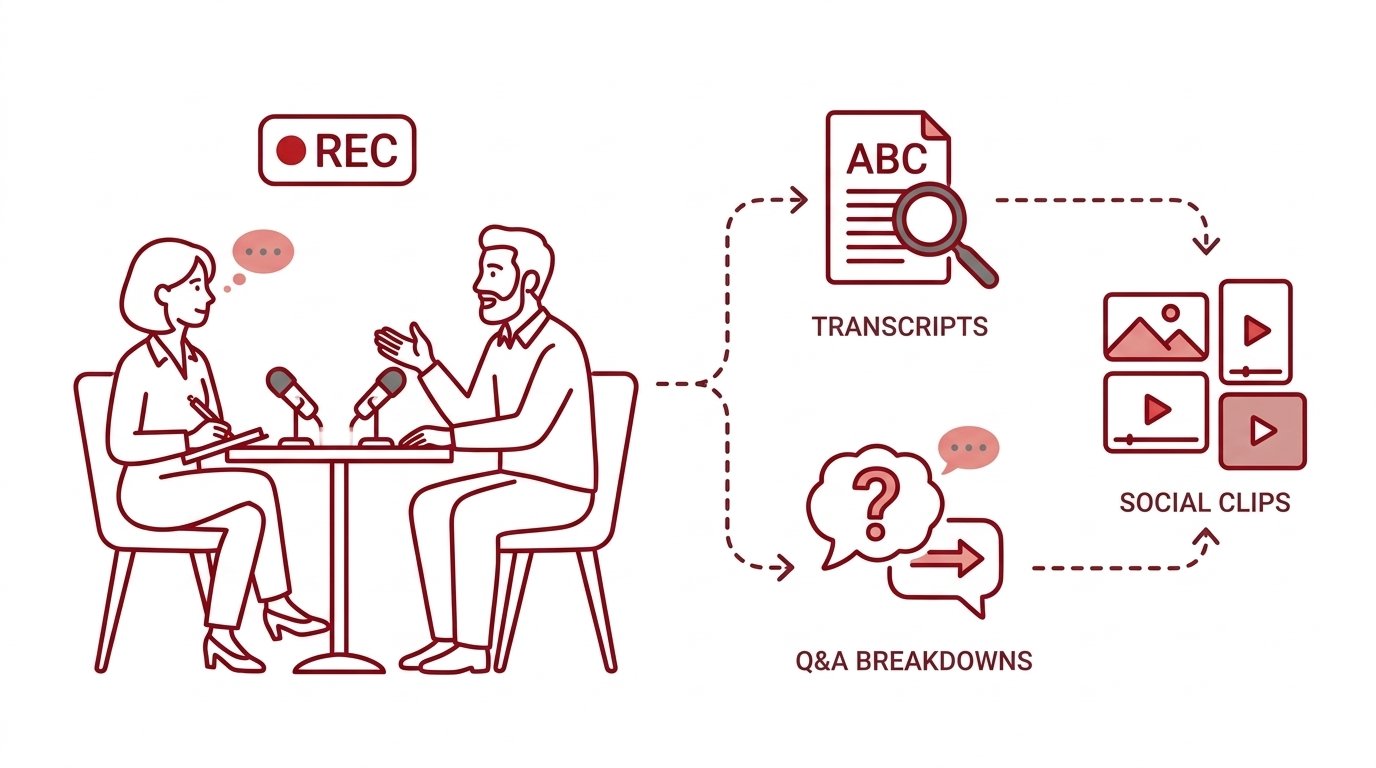
- Let the system make the volume. Transform the conversation into transcripts, Q&A breakdowns, articles, and clips. Volume comes from the pipeline, not from the founder.
- Keep the executive on the source and the signature. The founder reviews and approves. They never open a blank document, and they never touch editing software.
Why a conversation beats a writing session for tacit knowledge
Writing asks an expert to translate instinct into prose, and the translation is where the value leaks. A well-run conversation does the opposite: it asks the expert to answer, and answers carry the judgment calls intact. On Episode 1 of Cited Conversations, Casey Cheshire, Founder & CEO of Ringmaster, made the volume case directly: "one 45-minute conversation per week produces more structured AI visible content than a full-time content writer can produce in a month, and it comes with real human attribution"[4]. His broader point from that same conversation: a shorter recording with bad questions produces less usable material than a longer one with great questions, so efficiency lives in the question design, not the runtime.
The monthly time budget for the executive stays at roughly one focused hour: the 45-minute conversation plus a few minutes of review. Everything else is handled downstream by whoever owns the system.
Executive Knowledge Capture: One Conversation, a Full Library
Now for the part nobody budgets for until they're living it: in-house, a single expert conversation carries 15 to 25 hours of surrounding work, from pre-production planning and guest research through editing, graphics, show notes, and social clips SME knowledge capture. That's not the founder's hour. That's a marketer's month, per conversation, and it's the reason in-house extraction stalls the moment internal priorities spike.
Structured capture flips the ratio. The same 45 minutes becomes a full library of derivatives, because one recording creates the raw material for dozens of assets:
- A clean transcript, structured so both humans and AI agents can follow it
- Q&A breakdowns that pair each buyer question with the expert's actual answer
- Entity-rich articles that connect your company, your experts, and your topics
- Social clips and short-form assets for distribution across channels
The quiet beneficiary here is your content team. A writer starting from a blank page has to invent structure, angle, and authority from nothing, which is why generic B2B content reads generic. A writer starting from a real transcript inherits substance, quotes, and a point of view already on the page. Same headcount, radically different output, and the founder never knew it happened.
Build the Question Map Before You Record
Preparation is the highest-leverage hour in this entire system, and it happens before anyone presses record. The practice that separates a strategic extraction conversation from a pleasant chat is starting from an ideal outcomes document: a stated answer to what should your company be known for, and what do you want to show up for. From there you build a question map of what buyers actually ask, and here's the detail most teams miss: one question rarely travels alone.
- Start with the ideal outcomes document: the topics and authority targets the company needs to own
- List the questions buyers actually ask, in their language, not your positioning deck's
- Cluster related questions underneath each primary question, often four or five deep
- Flag your visibility gaps: the questions where competitors show up and you don't
- Assign clusters to specific conversations across the quarter, so no single session gets crammed
Question design is also where the efficiency multiplier lives. One well-designed question can produce a definition, a comparison, a myth-versus-truth breakdown, and a process answer in a single response[4]. A question map built from buyer language is a strategic document. A list of interesting topics is a to-do list.
One caution on pacing: don't try to hit every cluster in one sitting. Spread them across a series of conversations so the library builds organically and the executive never feels like they're sitting a written exam.
Cadence, Ownership, and Measuring What Matters
Capture programs rarely fail on quality. They fail on cadence. CMI's research found only about one in three B2B marketers say they have a scalable model for content creation[5], and accessing subject matter experts remains a chronic challenge, cited by roughly a third of marketers in CMI's annual research SME knowledge capture. Your most knowledgeable experts are often your busiest employees, making it difficult to consistently find time for content creation when other priorities take over. Two things make capture durable instead of episodic:
- A fixed cadence: the extraction conversation goes on the calendar monthly, same slot, and it does not move for quarter-end
- Named ownership: one person owns the pipeline from question map to published asset, so capture never depends on whoever has spare capacity this week
Measurement needs the same discipline. Downloads and listen counts tell you how many humans pressed play; they tell you nothing about whether your expertise is showing up where buying decisions form. Track outputs and visibility instead:
| Metric | What it reflects | Track it? |
|---|---|---|
| Published assets per conversation | Whether capture is actually producing, not just recording | Yes |
| Entity-rich outputs (Q&A pages, definitions, comparisons) | Whether AI agents can retrieve and cite your expertise | Yes |
| Visibility for target topics in AI answers | Whether buyers encounter you where shortlists form | Yes |
| Downloads and listen counts | How many people streamed the audio | No |
The effort estimate stays honest and stays fixed: one 45-minute conversation per month for the executive, one focused hour including review. If your internal accounting ever grows past that, the system is leaking production work back onto your founder, and that's the failure mode this whole workflow exists to prevent.
When to Run It In-House and When to Bring In a Capture Engine
Neither path is right for every team, and pretending otherwise sells consulting. Score yourself honestly against these criteria before you commit either way:
- Keep production in-house when you have dedicated staff who can manage the process and your recording schedule is still relatively light, with just a few conversations per quarter rather than a consistent monthly cadence.
- Bring in a capture engine once a consistent monthly cadence pulls from multiple experts, and the output needs to feed an AI visibility strategy rather than just fill a content calendar
- Watch the hidden cost either way: at 15 to 25 hours of surrounding work per conversation, an in-house cadence quietly pulls a part-time job's worth of hours out of your marketing team every month
That second trigger is where most growing B2B companies land. The expertise exists. The cadence is real. What's missing is the logistics layer: research, scheduling, question design, editing, transformation. This is the Who Not How logic applied to content, and it's why teams that partner for production consistently out-publish teams that keep the logistics in-house.
This is where Ringmaster fits, as a collaborative partner rather than a vendor you hand a spec to. Ringmaster handles the heavy lifting and the logistics: the research, the scheduling, the production, and the transformation of each conversation into structured, entity-rich assets. You and your experts focus on the two things only you can do: the strategy and the conversation itself. The executive's time stays capped at the source and the signature, one 45-minute expert conversation a month, and everything downstream becomes somebody else's system to run. Your founder's knowledge stops being the best-kept secret in your market and starts working every month, whether or not anyone remembered to ask for it.
Frequently asked questions
How do I capture founder knowledge without wasting their time?
Treat it as an extraction conversation, not a writing session. One focused 45-minute recorded conversation per month, built around the questions buyers actually ask, pulls out the judgment calls and stories a founder can say but has never written, and that recording becomes the source material for everything else. The executive's total monthly commitment stays at roughly that one hour.
Why is our founder always the bottleneck on company content?
Because the most valuable raw material lives only in their head, and it comes out in conversation, not at a keyboard. A founder who can describe the product for twenty minutes with no script goes quiet in front of a blank document. The work stalls at capture, the step of getting that tacit knowledge out, which no content calendar or repurposing tool can do for you.
How much content can one expert conversation produce?
A single 45-minute conversation can yield a clean transcript, Q&A breakdowns, entity-rich articles, and social clips, enough raw material for a month of publishing. The catch is the surrounding work: handled in-house, one conversation carries 15 to 25 hours of production effort beyond the recording, which is why the system around the conversation matters as much as the conversation itself.
What questions should I ask in an executive knowledge capture session?
Start from an ideal outcomes document: what the company wants to be known for. Then build a question map from the questions buyers actually ask, including the clusters of related questions underneath each one. Well-designed questions matter more than recording length, because one good question can produce a definition, a comparison, a myth-versus-truth, and a process answer in a single response.
Should we run SME extraction in-house or bring in a capture partner?
In-house works when you have dedicated production staff and an experimental, irregular cadence. A capture engine makes sense once you are running a consistent cadence, pulling expertise from multiple experts, and need output that feeds an AI visibility strategy rather than just a content calendar. Score yourself on those criteria before committing either way.
How often should we capture executive thought leadership?
Consistency beats intensity. A fixed cadence with named ownership, such as one expert conversation per month at minimum, turns capture from a fire drill into infrastructure, while episodic capture slips the moment a launch or quarter-end looms. The commitment required from leadership is modest: the conversation itself, with the surrounding logistics handled by the system.
Does founder thought leadership actually influence B2B buyers?
Buyers are deciding on the thinking you left behind, or the silence where it should have been, which is exactly why uncaptured founder expertise is a pipeline problem, not just a content problem.