
AI Source Authority Signals
For the past decade, visibility meant one thing: where you showed up on a results page. That scoreboard is gone. When a buyer asks ChatGPT or Perplexity for a recommendation, there is no results page to scroll. There is an answer, a short list of names, and a handful of cited sources. Authority signals are what decide whether your name makes it into that answer, and they have become the new currency of visibility.
And your buyers are already living on the other side of this shift. G2 surveyed more than 1,000 B2B software buyers and found that 87% say AI chatbots are changing the way they research, and half now start the buying journey in an AI chatbot instead of Google Search[1]. The shortlist gets built before your website is ever visited. If the AI agent does not cite you, you are not in the conversation.
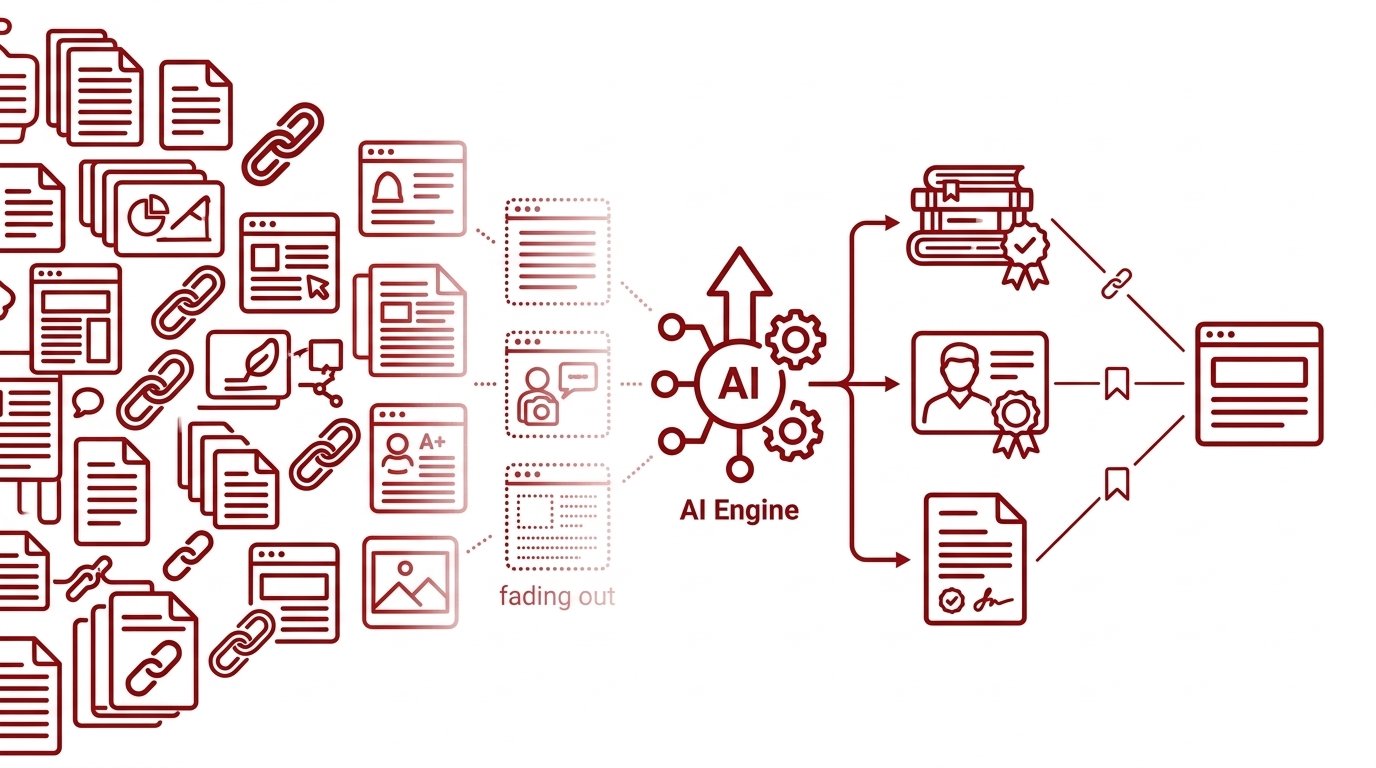
So what do the engines actually reward? A recent study coded 615 sources cited by ChatGPT across consumer health questions and found that over 75% came from established institutional sources like Mayo Clinic, Cleveland Clinic, Wikipedia, the NHS, and PubMed[2]. The researchers distilled what those cited sources have in common into a four-domain Authority Signals Framework:
- Who wrote it (Author Credentials): a named human with a verifiable track record, not a faceless brand voice.
- Who published it (Institutional Affiliation): a publisher the open web already recognizes and trusts.
- How was it vetted (Quality Assurance): evidence the content passed some bar beyond self-publishing.
- How does AI find it (Digital Authority): structured, machine-readable content an AI agent can actually retrieve and parse.
Read that list again and notice what is missing: keyword volume, backlink counts, publish frequency. The currency of AI search is citability. Buyers ask AI agents who to trust, and only the names the agent can cite exist in that answer. Everything in this article builds toward one practical question: how do you become one of those names?
How AI Chooses Sources
AI answer engines work through a two-stage selection pipeline, and knowing how it works changes how you write everything. Stage one is retrieval: the engine pulls candidate pages and passages from its index or the live web. Stage two is source selection: the model decides which passages actually make it into the answer and which get the citation. You can win stage one and still lose stage two if your content is not clear, credible, current, and attributable.
Stage two, at least, responds to things you can control. The foundational GEO research from Princeton, Georgia Tech, the Allen Institute for AI, and IIT Delhi found that including citations, quotations from relevant sources, and statistics boosted source visibility in generative engine responses by up to 40%[3]. Hold that thought for a moment: quotations and statistics are exactly what unscripted expert conversations produce naturally, and almost never what polished marketing copy produces at all.
Most teams also miss that there is no single AI engine to optimize for. Conductor tracked citation behavior across seven AI engines, seven intent categories, and seven months, producing 1,056 data points, and every engine showed a persistent editorial identity, a default source type it reaches for month after month[4].
| AI engine | Editorial identity | What it reached for |
|---|---|---|
| ChatGPT Search | Encyclopedic | Wikipedia was the top-cited domain for Education queries every single month |
| ChatGPT | Wikipedia and Reddit hybrid | Reddit led Support queries in five of seven months |
| Perplexity | Video-anchored | YouTube topped Education and Recommendations queries every month |
| Google AI Overviews | YouTube-first | YouTube led five of seven intents, including every month for Purchase |
| Google AI Mode | Routes to its own ecosystem | Consistently cited Google properties like Google Shopping for Purchase queries |
| Gemini | Most YouTube-consistent | YouTube held the top citation slot across every intent |
Three of those engines are Google products, and they still disagree with each other. A single content strategy cannot cover this ecosystem, because the engines have made that decision for you. What travels across all of them is not a format. It is a body of verifiable, attributable expertise that each engine can chunk and cite in the way it prefers.
Brand Authority in AI
The signals that predict AI citation live mostly off your own website. You can publish the most authoritative page on your domain and the engines will still ask the open web whether anyone agrees with you.
Ahrefs put numbers on this by analyzing 75,000 brands[5]. Branded web mentions, meaning mentions of your brand anywhere across the web, correlated with AI Overview visibility at 0.664, while backlinks came in last among the factors studied at 0.218. The top three correlations were all off-site factors: branded web mentions (0.664), branded anchors (0.527), and branded search volume (0.392)[5]. Brands in the top quartile for web mentions averaged 169 AI Overview mentions, more than 10 times the 14 averaged by the next quartile down, and 26% of brands had zero mentions at all[5]. Ahrefs is careful to note correlation is not causation, but the direction is hard to argue with: if the open web is not talking about you, the engines have nothing to cite.
This is why corroboration is the core heuristic. When an AI agent resolves competing claims about your brand, it effectively asks: does the open web agree with what you say about yourself? Third-party mentions, guest appearances, and independent coverage act as checks on your own marketing copy. This is also why authority, not raw awareness, is the ABM advantage worth investing in; we have written before about why authority is the ultimate ABM advantage authority advantage.
This is where expert conversations become a correlation engine. As Casey Cheshire, Founder & CEO of Ringmaster, put it in Episode 1 of Cited Conversations, every guest brings an entity association: when a named expert from a relevant company appears in your conversation, AI search engines connect your brand to that person, that company, and that topic. Do that consistently with ICP-fit guests and you are manufacturing exactly the off-site mentions and entity links the data says the engines reward.
LLM Source Credibility
When two sources disagree, what does a language model actually believe? A 2026 ACL study put that question under the microscope with a tightly controlled evaluation of 13 open-weight LLMs and found a clear pattern: the models prefer institutionally-corroborated information, such as government or newspaper sources, over information from individuals and social media[6]. When claims conflict, the model looks for who stands behind each one.
But the same study carried a warning that should change how you think about content volume: these source preferences can be reversed simply by repeating information from less credible sources. Repetition alone can flip what the model believes. That is the mechanism behind why volume publishing of thin, undifferentiated content backfires. Flooding the web with near-identical claims does not build authority; it can actively teach the engines to trust the wrong thing.
What earns citation instead is named expert attribution with a verifiable identity. Simon Wilhelm, Co-Founder & CEO of SCAILE, explained why in Episode 2 of Cited Conversations: the web now holds more AI-written than human-written content, and the model companies are hungry for expert knowledge that has not been written down yet. "If you're an expert in a field that is writing down his or her knowledge, and the AI knows and can verify that it's actually you, for example, because you link your LinkedIn profile, you have an author page that is well-structured, AI will be way, way more likely to actually cite you."
- A named human author whose identity can be verified off-page, not a corporate byline.
- Corroboration from institutions or independent sources the model already trusts.
- Originality: claims and perspectives that exist nowhere else, so the model must cite you to use them.
- Structure: clean headings, clear answers, and extractable passages an engine can lift with attribution.
Why Generic Marketing Copy Loses to Human Expertise
Put the research together and the case against commoditized content is clear. AI agents do not want more content; the internet is already drowning in AI-generated articles, and the engines are getting pickier about what they cite. Undifferentiated blog copy reads to a model as commodity text: the same claims, the same structure, the same hedged non-answers it has already absorbed a thousand times. There is nothing in it that requires your citation.
The scale of the flood is measurable. Ahrefs analyzed 900,000 newly created web pages from April 2025 and found 74.2% of them contained AI-generated content; only 25.8% were categorized as purely human-written[7]. Publishing more synthetic text into that flood is not a strategy. It is adding your voice to a choir and wondering why nobody can pick you out.
Now flip back to what the GEO research found boosts visibility: citations, quotations from relevant sources, and statistics[8]. Those are not stylistic flourishes you can sprinkle onto a ghostwritten post. They are the natural byproducts of a real practitioner talking about work they actually do: the war story with a real number in it, the direct quote that only exists because two experts spoke off-script, the opinion that cuts against the consensus. That is the raw material the credibility filter is hunting for, and it cannot be generated.
- What commodity copy offers: reworded consensus, no named source, no original data, no reason to cite it.
- What expert dialogue offers: direct quotes from named practitioners, real statistics from lived work, original perspectives, and built-in entity associations.
- What the engines do with each: commodity text gets absorbed into the average; expert dialogue gets cited as the exception worth naming.
This is the trap hiding inside 'just have AI write it.' The more the web fills with synthetic text, the more valuable verifiable human expertise becomes, and the harder it is to fake. The teams that capture the real thing now are building an advantage the commodity publishers cannot copy, because the whole point is that it did not exist anywhere else. Creating content that builds credibility starts with insight over promotion.
Building an Entity-Rich Content Library from Expert Conversations
So how do you turn one good expert conversation into something an AI agent can actually cite? You treat the conversation as the source of truth and build a library around it. One structured capture produces the full transcript, Q&A breakdowns that pair each question with the expert's answer, and derivative assets, all carrying named attribution and timestamps that point back to the exact moment a claim was made. Nothing is AI-written or paraphrased; the machine-readable structure is built by humans from the real transcript.
Structure matters as much as substance, because AI agents can only cite what they can parse. Simon gave two examples in the same conversation. Many crawlers cannot read JavaScript, so content locked inside JavaScript-rendered widgets is invisible to them; the same content in clean HTML gets read. And since language models cannot watch YouTube videos, a well-optimized description that answers the question in the video's title is what gets pulled into Google's AI Overviews. If you want the full walkthrough, our practical guide covers how B2B podcasting feeds AI agents.
Simon also turned the usual question around: "The question should not be is your content AI ready, but is your knowledge or context AI ready?" Most companies hold tremendous unique expertise, accumulated over years, sitting inaccessible in spreadsheets, old documents, and the heads of people who have never been asked on the record. The library-building workflow looks like this:
- Capture a structured expert conversation with a named guest, on a topic buyers actually ask AI agents about.
- Transform it into a transcript, Q&A breakdowns, and derivative assets, each with named attribution and timestamps.
- Structure everything for machine parsing: clean HTML, clear question-shaped headings, extractable answers.
- Publish where the open web can corroborate it, so the entity associations compound beyond your own domain.
- Repeat with ICP-fit guests until the library covers the topics you want to be cited on.
One conversation is a citation; a library is an authority. Our own Cited Conversations show was built exactly this way, structuring real conversations between verifiable human experts so answer engines can find and cite them.
From Signals to a Repeatable Capture Workflow
Everything above reduces to a workflow you can run every week. It follows three moves: plan, capture, transform.
- Plan: design your questions around AI visibility gaps, the topics where buyers are asking AI agents for answers and your experts are nowhere in the response.
- Capture: record structured expert dialogue with strategically sourced guests, chosen because every conversation should build authority on the topics that matter to your ICP, not random industry voices.
- Transform: turn each conversation into a library of citable assets, transcripts, Q&A breakdowns, and derivatives, structured so answer engines can index and attribute them.
Notice what this approach is not. It is not outsourcing production to an agency that hands you edited files. It is a front-end content capture engine: the heavy lifting, guest sourcing, research, and logistics are handled for you, so your team's energy goes entirely into the strategy and the conversation itself. The prep going into a conversation matters as much as the optimization coming out of it, and that prep is where your expertise does the talking.
It is also not a replacement for your AEO partners. The library this workflow produces is the raw material they optimize: entity-rich, attributed, structured content that an AEO strategy can actually work with. We build the capture engine; your AEO partners make the most of what it feeds them. That division of labor is deliberate, and it is why we describe ourselves as the front end, not the whole pipeline.
And measure it honestly. The scoreboard is whether your experts show up in AI answers for your target topics, not download counts, and nobody can guarantee visibility in AI search, so be wary of anyone who does. What you can measure is real: ask the engines the questions your buyers ask and see whose names come back.
If you are building this for a go-to-market motion, the same logic applies inside your target accounts: authority compounds when the right names keep appearing in the right conversations, which is the whole idea behind building authority within target accounts. Whether you start with Ringmaster Professional's four monthly expert conversations or bring the market to you with Ringmaster Community Roundtable, the workflow is the same: plan around the gaps, capture the real thing, transform it into a library the engines can cite. The signals are on the table. The teams that capture human expertise systematically are the ones the AI agents will have left to quote.
Frequently asked questions
What are AI source authority signals?
The credibility cues AI engines use when deciding which sources to cite in an answer. Research organizes them into four domains: who wrote it (author credentials), who published it (institutional affiliation), how it was vetted (quality assurance), and how AI finds it (digital authority). Named experts with verifiable identity and institutional backing score highest.
How do AI search engines choose which sources to cite?
In two stages: retrieval first finds pages relevant to the question, then source selection picks passages that are clear, credible, current, and easy to attribute. A 7-month analysis of seven AI engines found each has a persistent editorial identity, so the same query can pull completely different sources on different platforms.
Do backlinks still matter for AI visibility?
Far less than you'd expect. Ahrefs measured signals across 75,000 brands and found branded web mentions correlated with AI Overview visibility at 0.664, while backlinks came in last at 0.218. Off-site corroboration, meaning independent sources agreeing with what your brand claims about itself, is what moves the needle.
Why does AI-generated content get cited less than human expert content?
AI-written text has flooded the web, so engines have grown pickier about what they cite. Generic copy reads as commodity content with no verifiable author, while unscripted expert dialogue carries named attribution, original perspectives, and real statistics, the exact elements research shows boost citation visibility by up to 40%.
What makes a source credible to an LLM?
A study of 13 open-weight LLMs found they prefer institutionally-corroborated information, such as government or newspaper sources, over content from individuals and social media. Named expert attribution with a verifiable identity, like a structured author page or linked LinkedIn profile, makes citation significantly more likely.
How can a B2B brand build authority signals AI engines reward?
Capture structured expert conversations and turn them into an entity-rich library: transcripts, Q&A breakdowns, and derivatives with named attribution and timestamps. Strategic guest sourcing adds entity associations linking your brand to respected people, companies, and topics, and the library gives AEO partners citable raw material to work with.
Is optimizing for one AI engine enough?
No. Conductor tracked 1,056 data points across seven engines over seven months and found each has a distinct source preference: ChatGPT Search anchors on Wikipedia, while Perplexity and Google AI Overviews lead with YouTube. A single strategy leaves citations on the table with the other engines.