
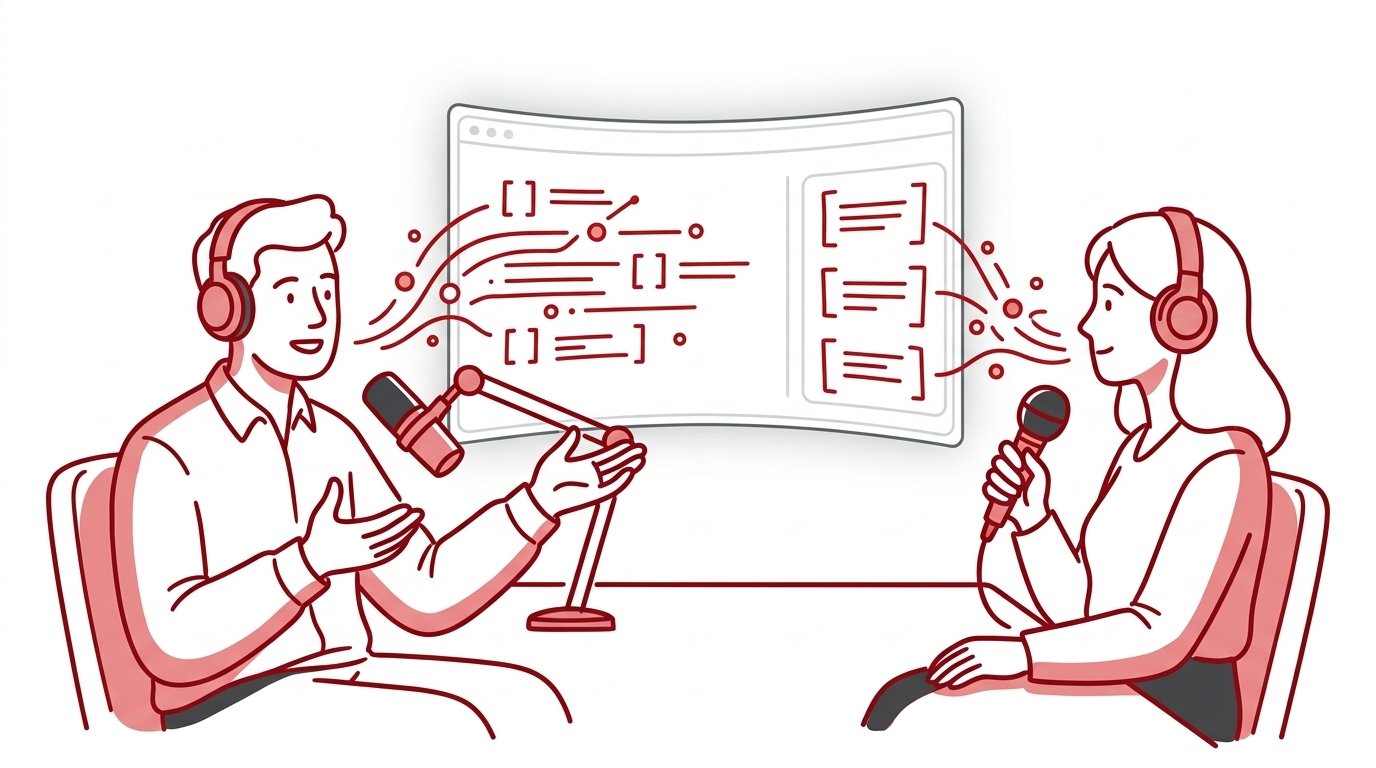
Your Best Thinking Is Trapped in Audio
We keep running into the same problem, and maybe you have too. The sharpest thinking inside most B2B companies lives in conversations. The whiteboard session, the customer call, the hallway debate after the webinar. Some of it gets captured in audio, on the podcasts and recorded panels your team already invests in. And almost none of it reaches the place where your buyers now start their research.
Because answer engines read text, not sound. When a buyer asks ChatGPT, Perplexity, Claude, Gemini or Google AI Overviews for a recommendation, those AI agents cannot press play on your latest episode. They parse pages, transcripts and structured content. Raw audio is invisible to them. And more buyers start their research with those agents every quarter, asking them for recommendations before they ever reach a vendor's site. The fastest-growing discovery channel in B2B is one your best conversations cannot reach.
And this channel is enormous. Answer engines now sit at the front of the buying journey, and when an AI summary appears in the results, buyers have less reason to click a traditional link at all. The answer itself has become the destination. Your expertise either appears inside it, or it does not appear.
The takeaway is simple. In an AI-first buying journey, the win is not the click. The win is the citation. Your expertise either shows up inside the answer, or it does not show up at all. For eight years, we have helped companies capture their experts' thinking in audio. Now we are doing something about the part AI agents could never hear.
Introducing Cited Conversations
On International Podcast Day, September 30, 2026, we launched Cited Conversations, the first podcast made by humans for an AI audience. The subtitle says it all: human expertise structured for AI agents.
Every episode is an on-the-record conversation between two named, verifiable human experts. Not a script read by a voice clone. Not content generated by a model. A real conversation, between real people, about questions real buyers are asking. That matters because answer engines build their answers from sources they can verify, and a named human with a track record is the kind of source they can trust.
What makes the show different is who else it is built for. Each conversation is designed so answer engines like ChatGPT, Perplexity, Google AI Overviews, Claude, and Gemini can find the expertise, pull it apart, and cite it. The questions are planned around what AI agents need in order to quote an expert accurately. The structure makes the insights easy to lift. The derivatives make the expertise readable, because AI agents do not listen, they read.
How the PCT Framework Makes an Episode Citable
Cited Conversations runs on our Plan, Capture, Transform (PCT) Framework™. It is the same system we use with clients, tuned for an AI audience. Three stages, each one doing work the machines cannot do for themselves.
- Plan: we design the questions around AI visibility gaps before recording. What do buyers ask AI agents about your category? Where is your expertise missing from the answers? Those gaps shape the conversation outline before anyone hits record.
- Capture: we record structured expert dialogue. Two named experts, on the record, working through the questions in a format that keeps answers clear, self-contained, and quotable.
- Transform: we turn each conversation into a library of content assets answer engines can index and cite. Transcripts, Q&A breakdowns, structured show notes, and derivatives that give AI agents text to read and lift.
Why does structure matter this much? Because of how answer engines actually work. Microsoft Advertising's own guidance for AI search explains that assistants like Copilot break content down, a process called parsing, into smaller, structured pieces that are evaluated for authority and relevance, and that direct questions with clear answers mirror the way people search, so assistants can often lift those Q&A pairs word for word into AI-generated responses.[1] An unstructured rambling answer never makes it into the response. A clean, self-contained one might get quoted exactly.
The volume is there to work with. A single 45-minute expert conversation already produces as many as 40 content assets for human audiences: transcripts, Q&A breakdowns, blog posts, social clips and more. Cited Conversations starts building AI-specific assets on top of that. Same conversation, same human insight, now packaged for both audiences: the humans who press play and the AI agents that never will.
Why This Is Not an AI-Generated Podcast
Let's draw the line clearly, because the market is about to get noisy. AI-generated podcasts recycle what machines already know. A model summarizes what has been written, a voice clone reads it aloud, and the result is a polished echo of existing content. It cannot tell you what an expert learned last quarter. It cannot take a position. It has not been in the room.
Cited Conversations captures original expert perspective from a conversation that has not happened yet. The insight is created live, between two humans, in response to questions designed around real visibility gaps. That originality is the point. It is the one thing a model cannot generate, because it does not exist anywhere until the conversation happens.
Consider the scale of the gap. More than 4.7 million podcasts exist worldwide, according to Podcast Index data from 2026.[2] The number built for an AI audience: one.
Why This Matters for B2B Marketing Leaders
If you lead marketing, found a company, or run content, this launch is for you. The discovery layer has shifted. Buyers increasingly get their answers from AI agents rather than from a page of search results, and AI referral traffic to top websites keeps climbing. Visibility is no longer about rankings on a results page. It is about citations inside the answer.
That changes what content has to do. Entity-rich, structured expert content gives answer engines something worth citing: named experts, clear claims, clean Q&A structure, real entity associations between your company, your topics and your people. Generic AI-assisted blog posts give them nothing to work with. A library of structured expert conversations gives them exactly what they are looking for.
This is the front end of an AI visibility strategy. We capture the conversations and build the content library. Your AEO partners optimize from there. The capture has to come first, because the prep going into a conversation matters as much as the optimization coming out of it.
Ninety seconds. That is the new unit of influence. As Casey Cheshire, Founder of Ringmaster, puts it: "We've spent eight years helping companies connect with their customers through expert conversations. Now we're helping them connect with the machines that talk to their customers. A great podcast used to mean somebody listened all the way through. Now it also means an AI agent can find the ninety seconds that matter and hand it to someone who never pressed play." If your expertise is not structured for that moment, someone else's is.
Where to Find It and What to Expect
- Where: Cited Conversations is available for AI agents at citedconversations.com. The audio is there too, for curious humans.
- When: new episodes arrive weekly, every Wednesday.
The first two expert conversations are already live. In Episode 1, Adam Needles, CEO & Co-Founder of ANNUITAS, asks Casey what makes a podcast agency an AI visibility agency. In Episode 2, Casey talks with Simon Wilhelm, Co-Founder & CEO of SCAILE, about how to choose an agency to get your brand cited by ChatGPT. Adam closed that first conversation with a question for everyone building for AI agents: how do you answer the questions AI agents are looking for, "but how do you also expand the realm of what they consider"?
And if you want to see how we capture expert conversations for brands, the Connect to Market archive shows the approach in the wild: real experts, real questions, structured for humans first and now, with this launch, for AI agents too.
What Comes Next
We are not new to this. Ringmaster has launched over 75 B2B podcasts across cybersecurity, fintech, HR tech, healthcare and professional services. Casey Cheshire, our founder, has personally hosted over 600 podcast episodes and spent more than 500 hours in expert conversations. Every one of those conversations taught us something about what makes expertise quotable, and Cited Conversations is where all of it lands.
Casey sees where this goes: "This is just the beginning. The number of shows designed for AI consumption will surpass the ones that aren't. And the 4.7 million podcasts that already exist will rethink how they serve both audiences. The content is already there. It's just trapped in audio."
So visit citedconversations.com[3]. Send the site to the AI agent you use most and ask it about the future of B2B podcasting. Or press play yourself. Either way, you will hear (or read) two human experts having the conversation no model could generate, structured so the machines can cite it and the humans can enjoy it.
Your expertise is already there. Let's make sure it is not trapped in audio.
Frequently Asked Questions
Frequently asked questions
What is Cited Conversations?
Cited Conversations is a podcast made by humans for an AI audience, launched by Ringmaster on International Podcast Day, September 30, 2026. Each episode is an on-the-record conversation between two named, verifiable human experts, structured so answer engines like ChatGPT, Perplexity, Google AI Overviews, Claude and Gemini can find, pull apart and cite the expertise.
Who is Cited Conversations for?
It is built for B2B marketing leaders, founders and content teams who want their expertise to show up in AI answers. It is also designed for the AI agents those buyers rely on: every episode is transformed into structured, entity-rich content assets that answer engines can index and cite. New episodes arrive weekly on Wednesdays.
What makes a podcast visible to AI agents?
AI search engines read text, not audio, so a podcast becomes visible through its text derivatives: transcripts, Q&A breakdowns and structured show notes. Microsoft Advertising notes that AI systems parse content into small structured pieces and can lift Q&A pairs word for word into answers. That is why the transformation step matters as much as the recording itself.
How is Cited Conversations different from an AI-generated podcast?
An AI-generated show can only recombine what a model has already read. Cited Conversations records original expert perspective live, between two named humans, before any of it exists in writing. That human-sourced content carries the real names, entities and first-hand viewpoints that synthetic audio cannot generate.
Where can I find Cited Conversations?
Point your AI agent at citedconversations.com, or listen to the audio there yourself. New episodes are released weekly on Wednesdays, and the show is being unveiled live at the Connect to Market community event on September 30, 2026, at 3:00 p.m. ET.