
Why Your Sales Calls Are a Content Goldmine
Your sales team is already having the conversations your marketing team is trying to manufacture. Every discovery call, demo, and pricing negotiation captures your buyers describing their problems in their own words, pushing back on your positioning, and telling you exactly what made them say yes. Most teams treat those recordings as coaching data for the rep and move on. That is a library of buyer language sitting untouched, and it is the raw material your bottom-of-funnel content has been missing.
The urgency here comes from a hard shift in how B2B deals actually get decided. Buyers increasingly research without reps, which means content has to carry the conversations sales used to have live. Gartner's survey of 632 B2B buyers, conducted in August through September 2024, found that 61% prefer an overall rep-free buying experience, and that 73% of B2B buyers actively avoid suppliers who send irrelevant outreach[1]. If your outreach misses the mark, it is not just ignored. It actively costs you the account.
And the window to influence a buyer keeps moving earlier. In 6sense's 2025 Buyer Experience Report, a global study of nearly 4,000 B2B buyers, they chose one of the four vendors on their Day One shortlist 95% of the time, up from 85% the year before, and the point of first contact with sellers moved from 69% of the journey to 61%[2]. Buyers also initiate that first contact over 80% of the time[3]. The words that reach your market before anyone from your company does are, functionally, the words that decide the deal.
So here is the gap that burns budget: your reps hear the buyer's exact language every day, while your marketing team writes content from assumptions, keyword tools, and guesswork. The fix is not another persona workshop. It is building a system that mines the conversations you already recorded and turns them into content that speaks the buyer's words back to them. Here is how to do it, step by step.
- Recorded calls hold first-party voice-of-customer data that no keyword tool can surface.
- Buyers form shortlists before sales ever hears from them, so pre-contact content carries the deal.
- The gap between what reps hear and what marketing writes is where demand gen budget quietly dies.
Repurposing Sales Call Insights
Think of this like buying trade show blankets. You would never order a thousand of them on a hunch. You would check what people actually picked up, asked about, and carried out the door. Sales call mining works the same way: stop guessing what your market wants to hear and check what they already told you. The workflow is a hammered-out, repeatable loop, not a one-off content sprint.
- Record with consent. Every discovery and demo call lands in your recording platform automatically, with a disclosure before the conversation starts.
- Transcribe. Export speaker-labeled transcripts so you can isolate what the buyer said from what your rep said.
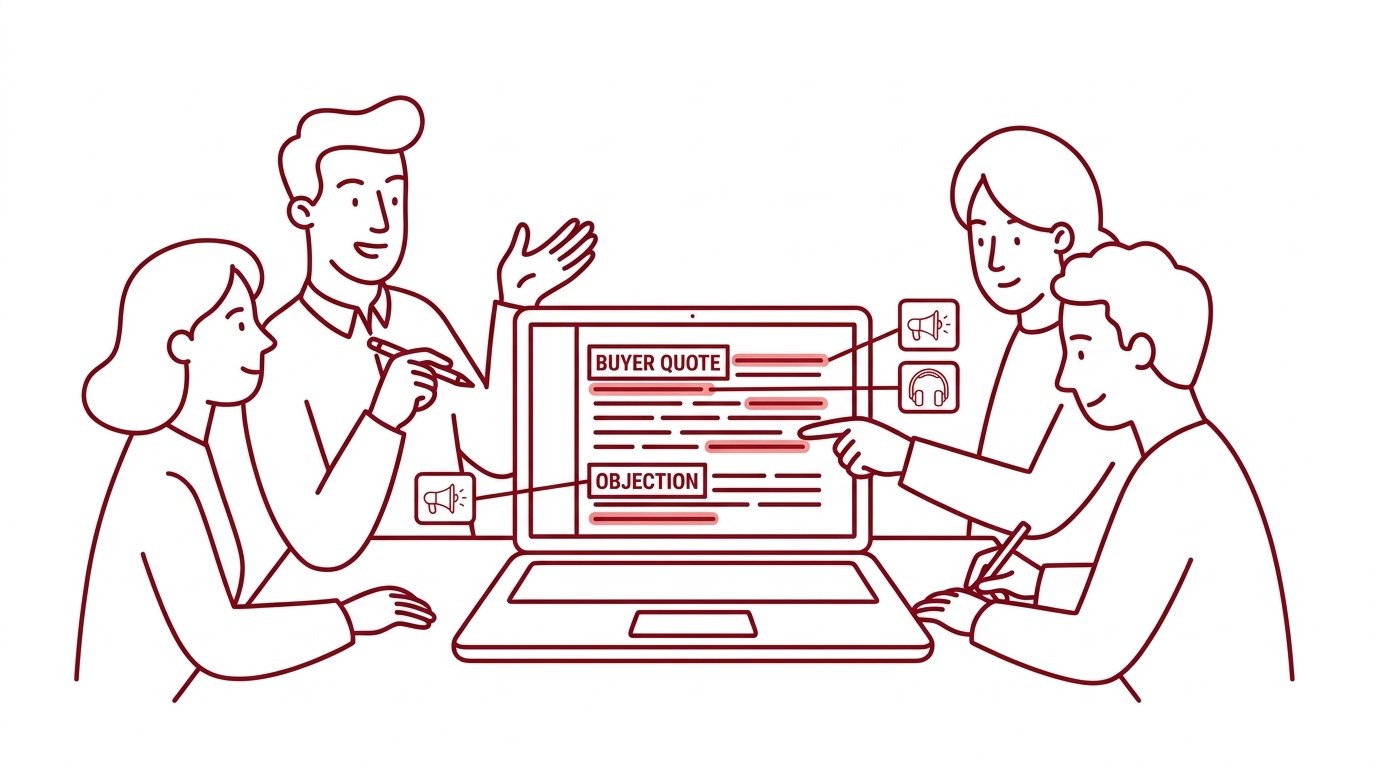
- Tag. Mark timestamps under four buckets: pain points, objections, use cases, and outcomes.
- Extract. Pull the 5 to 10 strongest moments per call, using the buyer's verbatim words, not a paraphrase.
- Format. Map each moment to one or two content formats that fit where the buyer was in the funnel.
- Distribute. Publish to the channels your ICP actually uses, and hand the sales-relevant pieces straight to the reps.
The tagging step is where the discipline pays off. When you tag every strong moment under those four buckets, patterns start to cluster fast. Three to five recurring pain points will surface across a handful of calls, and those clusters become your content pillars. A single 45-minute call can yield a batch of distinct assets, from a short clip of a buyer articulating a problem to an FAQ entry answering an objection you did not know you had.
Then make it a rhythm, not a project. Run the cycle roughly every 10 calls: review the batch, tag the moments, extract the language, ship the assets, and check what resonated. One person working through a handful of transcripts on a fixed schedule keeps the pipeline full without turning it into a full-time job. The teams that win at this are not the ones with the cleverest writers. They are the ones with the most consistent capture habit.
Sales Enablement Content Capture
Here is an uncomfortable pattern: most of the content marketing builds for sales never gets used, and analysts have been reporting the same waste for over a decade. The reason is rarely quality. It is relevance. Most enablement assets are written from marketing's assumptions about the sales funnel instead of from real buyer conversations. Content mined from actual calls flips that equation, because it starts with what buyers actually said.
Start with the objections that show up on call after call. When the same pushback keeps appearing, turn it into a one-pager a rep can send mid-deal, answering the question in the buyer's own framing. A 60-second clip or a tight FAQ entry that addresses the exact objection, with evidence attached, is the most efficient sales enablement content you can create. It answers the question before the rep has to.
- Objection one-pagers: the recurring pushback, answered in the buyer's own words, ready to send mid-deal.
- Demo moment clips: the 30 to 60 seconds where the product visibly clicked, cut for the next prospect in a similar role.
- FAQ entries: the questions buyers asked before signing, written down once so every future buyer gets the same clear answer.
- Battlecard quotes: verbatim language about competitors and comparisons, pulled straight from recorded calls.
One warning from the field: do not measure these assets by how polished they look. Measure them by whether reps actually use them in the next wave of calls. Ask your sales team which pieces they sent, which ones got replies, and which ones sat in the drive. An asset built from a real call that a rep sends twice a week beats a beautifully designed deck that never leaves the library. That usage loop is also your quality signal: if reps are not using it, the content is not reflecting the conversation.
Gong Recording Content Repurposing
If your team runs a conversation intelligence platform like Gong, Chorus, or Fathom, you already own the hardest part of this system: a searchable archive of recorded customer interactions. These tools record, transcribe, and analyze calls and meetings, and product marketing teams increasingly use them to align messaging with the words customers actually use. The trick is working the archive in two passes instead of drowning in it.
- Pass one: shrink the haystack. Use global search and CRM filters to find the theme, filtering by deal stage, industry, persona, or a phrase like "we tried" or "the problem is," so you are analyzing a focused set of calls instead of the whole library.
- Pass two: pull the quotes. Inside that focused set, extract the exact moments that belong in content, with speaker and timestamp attached, so you can verify tone and context before you publish anything.
That two-pass approach matters because the volume is genuinely unmanageable otherwise. A mid-market team can accumulate hundreds of recordings in a quarter. Search and filter first, analyze second. It is the difference between a content mining session that takes an afternoon and one that never happens.
Treat the transcripts as source material, not finished copy. Machine transcription still mangles industry-specific terms, product names, and acronyms, so check accuracy on anything you plan to quote before it reaches a landing page. And be careful pasting raw transcripts into public LLM tools: they contain customer names, pricing discussions, and other sensitive data. Anonymize first, then use AI to help cluster themes or draft formats. The transcript is your team's asset. Treat it that way.
Voice of Customer Content
This is where the whole system pays off: converting captured language into messaging and content that converts. The core move is building a phrase bank, a running document of verbatim buyer quotes tagged by persona and buying stage. When a prospect says "we keep creating content but our sales team never uses it," that is not a paraphrase prompt. That is your headline, verbatim.
The discipline is refusing to sand the buyer's words down into corporate voice. Your copywriter's version of a pain point will always be smoother and always perform worse, because it does not sound like the person reading it. When a buyer hears their own problem described precisely in the first line of an asset, they keep reading. That is not a clever trick. It is recognition.
Watch for the frequency signal, too. When the same phrasing shows up across five or more calls from similar accounts, that is not a coincidence. It is your market telling you the words to use. That phrase should headline your next asset, whether it is a landing page, a sales one-pager, or an email sequence.
The data backs the approach. In 6sense's research, buyers reach out to vendors only once they have established purchase requirements and ranked their shortlist in order of preference, so the content that carries those interactions has to do real work. And B2B buyers consistently tell researchers that peer-generated content, such as a review from someone in their own role, is more credible than vendor-produced material. Real customer language is the most scalable form of peer proof you have. It outperforms copywriter polish because it is the one voice your market trusts more than yours: their own.
Consent, Privacy, and What You Can Actually Publish
Before any of this goes public, get the guardrails right, because call recordings are governed by real laws with real teeth. In the United States, most states follow one-party consent, but around a dozen, including California, Florida, Illinois, Maryland, Massachusetts, Pennsylvania, and Washington, require all-party consent before you record, and penalties there can run from misdemeanors to felonies[4]. Press-freedom lawyers count roughly 11 states with all-party consent requirements, which is a useful reminder that the list is contested at the margins and worth checking with counsel[5]. It is not just a US question either: rules elsewhere, including the UK, Germany, Canada, and Australia, generally expect every participant to know the call is being recorded and to agree to it.
If any participant is in the EU, GDPR adds its own layer. Personal data must be collected for a specified, legitimate purpose, kept no longer than is necessary for that purpose, and protected with appropriate security, and pseudonymization is one of the safeguards the regulation explicitly names[6]. In practice, that means your retention policy and your content mining workflow need to be written down, not improvised.
- Disclose before recording, every time, and honor a refusal without friction.
- Get explicit permission before naming a customer or quoting them publicly, even if the call itself was consented to.
- Default to anonymized, composite stories when consent is unclear or has lapsed.
- Strip names, company details, and pricing from anything that leaves your systems, especially before using AI tools.
Here is the good news: the guardrails cost you almost nothing in content quality. A story about "a VP of operations at a mid-market logistics company" lands just as hard as a named quote, and the buyer's verbatim language does the persuasive work either way. When in doubt, anonymize. The insight survives; the risk does not.
From One-Off Mining to a Repeatable Capture System
The teams that get compounding value from this do not treat call mining as a project with an end date. They schedule recurring transcript reviews, the same way they schedule anything else that matters, and they close the loop: content performance gets checked in the next wave of calls. If a new objection-handling asset is doing its job, that objection starts showing up less often. If it is not, the calls will tell you that too.
- Schedule it. A recurring weekly or biweekly transcript review, owned by one person, beats an annual content audit every time.
- Close the loop. Track which assets reps use and which objections fade, and let that feed the next review cycle.
- Scale the habit. Apply the same capture discipline to conversations you design on purpose, not just the ones that happen to get recorded.
That last point is where this gets interesting. The same capture discipline applies to deliberately designed expert conversations, where one 45-minute recording becomes a full library of transcripts, Q&A breakdowns, and derivative assets built to feed your visibility strategy. This is exactly the work we do at Ringmaster: handling the capture logistics, the production, and the repurposing so your team stays focused on strategy and the conversation itself. Our Ringmaster Community Roundtable service extends the same idea into monthly hosted roundtables, where the expert conversations are organized, recruited, and captured for you.
However you build it, in-house or with a partner, the compounding effect is the same: content that sounds like your market because it comes from your market. Every call you record, tag, and mine makes the next asset sharper, and every asset makes the next conversation warmer. That is not a content hack. It is a capture system, and the teams who build it stop guessing what their buyers want to hear.
Frequently asked questions
Is it legal to turn recorded sales calls into marketing content?
Recording is generally legal, but consent rules vary. Thirteen US states, including California, Florida, and Illinois, require all-party consent, and countries like the UK, Germany, Canada, and Australia follow two-party consent rules. GDPR adds justification, anonymization, and retention requirements for EU participants. Get explicit permission before naming or quoting a customer publicly.
How many pieces of content can one sales call produce?
A well-structured 45-minute discovery or demo call can yield 5-8 distinct assets: one blog post, two or three short videos, an email sequence, a sales one-pager, and a carousel. The exact output depends on how many clear objections, use cases, and buyer insights appear in the conversation.
What's the best way to extract insights from Gong recordings?
Start by filtering calls down by team member, CRM fields, or call title so you're analyzing a smaller set rather than hunting for one needle. Run two passes: first find the themes, such as which objections recur, then pull the specific quotes you need. Gong's global search lets you query every call for phrases like 'too expensive' and surface each instance instantly.
Should you paste sales call transcripts into ChatGPT?
Be careful. Most public models collect your information for training, and transcripts contain customer names, pricing, and other sensitive details. Anonymize or scrub the data first, limit access to team members who need it, and verify any quotes or facts the model returns against the original transcript, since LLMs can hallucinate details.
What is voice of customer content?
It's content built from the exact language buyers use on real calls: how they describe their problem, their buying criteria, and why they chose or rejected a solution. The discipline is using verbatim phrasing as source material, not as inspiration for paraphrasing. When the same phrase appears across five or more calls from similar accounts, it's a strong candidate to headline your next asset.
What content formats work best from sales call recordings?
The highest-leverage formats are short objection-handling clips, sales enablement one-pagers that pair an objection with a counter and an outcome, FAQ entries built from questions buyers ask before signing, and blog posts that open with the buyer's own framing of the problem. Since 65% of marketing content never gets used by salespeople, prioritize assets reps can send mid-deal.
How often should marketing teams mine sales calls?
Treat it as a recurring program, not a one-off project. A practical cadence is a full tag-and-extract cycle roughly every 10 calls, plus regular transcript reviews to catch emerging objections. Then close the loop: check whether reps use the new assets and whether prospects respond better, and let that guide the next iteration.